An Authentic Dawn for Online Private Schooling - SmartBean
A sign of the direction in which things are moving?

Monday, August 31, 2009

Friday, August 21, 2009
Wednesday, August 19, 2009
Recommended Fiction for Tweens (9-12 year olds) - SmartBean
Recommended Fiction for Tweens (9-12 year olds) - SmartBean
Awesome reading list for 9-12 year olds - favorite authors and series. Must check out if you are a parent or teacher or tweens!
Awesome reading list for 9-12 year olds - favorite authors and series. Must check out if you are a parent or teacher or tweens!
Monday, August 17, 2009
Wednesday, August 05, 2009
Five Competencies for Adapting to a Changing World - SmartBean
Five Competencies for Adapting to a Changing World - SmartBean
(Shared via AddThis)
A very interesting series of videos for parents and educators on SmartBean on the general theme of 21st century competencies and how new technologies will impact the future of education.
(Shared via AddThis)
A very interesting series of videos for parents and educators on SmartBean on the general theme of 21st century competencies and how new technologies will impact the future of education.
Tuesday, April 21, 2009
Moving About in Class Helps to Prime the Brain for Learning.
This article on SmartBean comes as great news. My younger son is one of those who just cannot sit still and needs to move about all the time. He was often censured in his classroom in India for not conforming to the inane rule of sitting/standing still while talking or doing other activities in class. Knowing him as well as my husband and I do, we can actually see his brain at work, absorbing every little detail, even when he is seemingly not paying attention and just walking about on those rare occasions when we're reading to him (rare now since he is a voracious reader himself). I can see so clearly how physical activity primes this kid's brain for processing information and learning.
Friday, February 06, 2009
Google India takes the internet to the masses

On Feb 3rd, Google launched the "Internet Bus Project". Simply put, this is a campaign to take the internet - quite literally on wheels - right to people in the smaller cities in India who are still not participating in what is now part and parcel of our lives in urban centers. The campaign has been launched in Tamil Nadu where the Bus will visit 15 towns in the next 45 days.
An interesting, and noble, aspect about this initiative is that the focus is the Internet and not Google, per se, as is evidenced by the videos that have been uploaded to the Internet Bus Google page as well as the internetbus channel on youtube (and are shown to visitors on the Bus as well). The video on "Internet for Communication" for example, shows facebook and Yahoo IM as means of social networking and communicating in the same breath as Orkut and Google Talk. Similarly, several sites and online services that work well to make day-to-day life easier for Indians - from online news (in Indian languages in addition to English) to cricket to matrimony to jobs to railways to e-gov - and are showcased in the videos, have nothing to do with Google.
Another worthwhile aspect being highlighted by the Internet Bus is the Indian-language Internet. Communication via the internet, as well as creation and consumption of content in Indian languages, such as Tamil, Hindi, and several others, is possible, but not a well-known feature among certain demographics in India, who perhaps view the internet as a service and convenience that can be enjoyed only in the English language. How many of us have visited the Hindi or Tamil wikipedia (which now has thousands of pages in at least 10 Indian languages, the highest number being in Telugu!)? [On a side note, this 'list of wikipedias' is an interesting page to study.]
The internet is being presented to the Bus visitors in 4 themes - Internet for --
- Information
- Communication
- Education
- Entertainment
With access (computer hardware as well as connectivity) becoming cheaper by the day, and more and more Indic content as well as Indic language tools being made available to Indians (by Google and others), it just does not make sense for the large percentage of Indians in smaller towns to not avail themselves of the affordances of the internet, and to remain marginalized from the global revolution that is the internet.
Go Google! Go Internet Bus! Go India!
-----------------------------------------------------------------------------------------------
Here's some press from the launch event in Chennai on Feb 3rd -
- Official Google India Blog - India Internet Bus Project rolls in
- The Hindu - Google rolls out the 'Internet Bus'
- Techtree.com - Google Internet Bus Comes to India
- IBNLive.com - Google Internet Bus Project Kicks Off in Tamil Nadu
-----------------------------------------------------------------------------------------------
Tuesday, February 03, 2009
A Vision of K-12 Students Today
(Cross-posted on educatorslog.in)
Kids today are often referred to as “digital natives” (an idea that has been described here and here on this blog). They enjoy being able to express themselves through the many digital technologies that they are so facile with; technologies that they would enjoy putting to use for the purposes of learning (and school work) as well.
This video was created to inspire teachers to use technology in engaging ways to help students develop higher level thinking skills and be better prepared to succeed in the century. It is just as important for parents to understand, and sync up, with their digital kids.
‘A Vision of K-12 Students Today’ was probably inspired by an earlier video ‘A Vision of Students Today‘ made by Michael Wesch in collaboration with 200 students at Kansas State University in which they share similar views (in similar fashion too) about their affinity for, and desire to use, digital media in higher education. This earlier post discusses Michael Wesch, his work on studying mediated cultures, and his popular channel on youtube.
Can India seriously pull off a $7 (or Rs. 500) laptop?
[Cross-posted on educatorslog.in]
In case you have not caught this on the news wire, India is all set to launch a $7 or Rs. 500 laptop. If India does manage to pull it off, it'll be quite a response to the OLPC $200 (originally the $100 laptop)!
"It forms part of the National Mission on Education through Information and Communication Technology, India’s new scheme to boost learning in rural areas through the internet." I do wonder about the fate of a project that has the Indian government behind it - I'd have bet on a private sector initiative to meet with better success, but there are some elite partnerships that are making this possible -
"The laptop is the result of cooperation between several of India’s elite technology institutions, including the Vellore Institute of Technology, the Indian Institute of Science in Bangalore and the Semi-conductor Laboratory that forms part of India’s Space Department. Private companies are also taking part."
Clearly, introducing a machine such as this and even flooding rural schools with it is not the answer to providing better education. The key is in training teachers and developing appropriate applications and curricula that will leverage this tool for better teaching and learning in the millions of classrooms that form part of the abysmal public school education system in India.
That said, I do hope that this machine makes it out the door - as a testimony to Indian engineering, if nothing else. Perhaps other details like the "how" of putting it to good use in classrooms will follow in due course. (I'm feeling strangely optimistic today :))
[Update: The spate of negative press that followed this news piece is disheartening, to say the least. It seems like the $7 or $10 was just a figure thrown up out of nowhere with no concrete details. See the links below. Even if it turns out that the government is hugely subsidizing this, I suppose it is alright, as long as in the end it is truly affordable for rural schools to use this....India could've done without egg on her face, though.]
Wednesday, January 07, 2009
'Education and Technology' Podcast in Science Magazine
In this Science magazine special podcast on education and technology, Professor Chris Dede of the Harvard Graduate School of Education talks about "immersive interfaces for learning." In the podcast, Dede explains what educators mean by "immersive interfaces" and the idea of leveraging a digital immersive environment for educating the "iKids" of today.
The companion article in Science (requires a subscription to read the full text), which Dede says is "about a set of opportunities that a particular type of interface represents and the opportunities [it presents]," explores his research on the intersection of education and virtual worlds through HGSE projects like River City and Harvard Augmented Reality Project (HARP).
Research in education on immersive interfaces like River City and HARP could potentially have a profound impact on the use of video and other multi-user virtual gaming environments in the context of ubiquitous learning in the coming decades.
This particular podcast also covers a story on how a new home e-learning system is leveling the educational playing field in Korea.
The companion article in Science (requires a subscription to read the full text), which Dede says is "about a set of opportunities that a particular type of interface represents and the opportunities [it presents]," explores his research on the intersection of education and virtual worlds through HGSE projects like River City and Harvard Augmented Reality Project (HARP).
Research in education on immersive interfaces like River City and HARP could potentially have a profound impact on the use of video and other multi-user virtual gaming environments in the context of ubiquitous learning in the coming decades.
This particular podcast also covers a story on how a new home e-learning system is leveling the educational playing field in Korea.
Tuesday, December 09, 2008
What is Education For?
This is one of those timeless pieces. Although it was written by David Orr in 1990, it is a valuable perspective - as valuable today as it ever was and ever will be. I had my 12 and 10-year olds read it and discuss it in the wake of what happened recently in Mumbai, and in the light of daily commentary on global warming and climate change.
I think high school children - old enough to debate global issues, participate in Model UNs and what not - should deliberate on the message in this speech. Although it was made as a commencement address to students graduating from college, I think kids should leave school - not college - with this message, so that it can shape what they study and do with their lives - and more importantly, how they do it.
One does not have to necessarily agree with everything David Orr says in this essay. It is enough that every citizen of this earth give this question deep and quality thought. When I look back on my studies in education at Harvard I feel that the paper on "What is the purpose of schooling?" was one of the defining moments of that academic sojourn. It was at once the most difficult and the most fulfilling exercise. I would give this question higher billing, and go a step further to contend that deliberation on this question could well be a critical part of human development, and must in some form or fashion, be part of every academic program - not just one on education.
I think high school children - old enough to debate global issues, participate in Model UNs and what not - should deliberate on the message in this speech. Although it was made as a commencement address to students graduating from college, I think kids should leave school - not college - with this message, so that it can shape what they study and do with their lives - and more importantly, how they do it.
One does not have to necessarily agree with everything David Orr says in this essay. It is enough that every citizen of this earth give this question deep and quality thought. When I look back on my studies in education at Harvard I feel that the paper on "What is the purpose of schooling?" was one of the defining moments of that academic sojourn. It was at once the most difficult and the most fulfilling exercise. I would give this question higher billing, and go a step further to contend that deliberation on this question could well be a critical part of human development, and must in some form or fashion, be part of every academic program - not just one on education.
Monday, December 08, 2008
Connectivism and The Networked Student
I spend much of my time reading, writing, discussing, and blogging about ideas around the broad theme of 21st Century learning. More specifically, what should 21st Century learning look like? How can social networking technologies be harnessed in learning spaces? How can emerging technologies truly, meaningfully impact the future of learning? How do we prepare our students and teachers for the challenges and opportunities of the 21st century?
This video on Connectivism and The Networked Student resonates with many of my views on the subject, and answers in part some of the questions raised above. No surprise that the video has a connection to the person some refer to as the "father of e-learning 2.0" - Stephen Downes.
"The Networked Student was inspired by CCK08, a Connectivism course offered by George Siemens and Stephen Downes during Fall 2008. It depicts an actual project completed by Wendy Drexler's high school students. The Networked Student concept map was inspired by Alec Couros' Networked Teacher. I hope that teachers will use it to help their colleagues, parents, and students understand networked learning in the 21st century." (Description of video on youtube).
Love the 'Paperworks' style of the Common Craft videos ...
This video on Connectivism and The Networked Student resonates with many of my views on the subject, and answers in part some of the questions raised above. No surprise that the video has a connection to the person some refer to as the "father of e-learning 2.0" - Stephen Downes.
"The Networked Student was inspired by CCK08, a Connectivism course offered by George Siemens and Stephen Downes during Fall 2008. It depicts an actual project completed by Wendy Drexler's high school students. The Networked Student concept map was inspired by Alec Couros' Networked Teacher. I hope that teachers will use it to help their colleagues, parents, and students understand networked learning in the 21st century." (Description of video on youtube).
Love the 'Paperworks' style of the Common Craft videos ...
Friday, November 28, 2008
Spore: Experiencing Evolution
A hugely anticipated PC game, Spore - was launched worldwide in September this year. This game has not only enthralled many kids and adults alike around the world, but also got educators talking about the value of this game in education - to help children learn about the concept of evolution, survival, migration, city development, trade and trade routes, and design of creatures and spaceships (among other things). The best part of Spore is that this learning is not overt - it just happens as kids play this immensely enjoyable (and addictive for some) game.
You can read about the accolades it has received and also visit the official spore website for more info, including an amazing demo of how you can nurture the creature your create through five stages of evolution: Cell, Creature, Tribe, Civilization, and Space.
Here's a write-up my 12-year old son Sidhanth wrote on his Spore experiences. He's enjoyed creating and uploading videos of his Spore creations to youtube - a cool feature that is integrated into the core functionality of the game.
Check out this Spore Ad video from the Spore youtube channel:
Monday, November 24, 2008
Chat Widget for Blogs
Here's an interesting tool that was shared on educatorslog.in yesterday - a live discussion widget that can add a chat feature to any blog or website.
It is of particular importance to India, as it incorporates the Google's transliteration API for typing indic scripts for Hindi, Tamil, Telugu, Malayalam and Kannada. It requires one to be signed in with their Google (gmail) account to make sure that only the signed in users leave comments.
It integrates with Google Talk as well so that people can see their "friend" lists and "presence" cues (online/offline/busy/other status).
I can potentially see a class gathering online for a discussion around a blog post that a teacher has posted as an assignment, or even groups of friends meeting online at a designated time to discuss homework on a class blog. I guess blogs and blogging need to become part of mainstream educational use by teachers and students before tools such as this can be leveraged for collaborative learning.
A neat idea and potentially useful tool nonetheless!
It is of particular importance to India, as it incorporates the Google's transliteration API for typing indic scripts for Hindi, Tamil, Telugu, Malayalam and Kannada. It requires one to be signed in with their Google (gmail) account to make sure that only the signed in users leave comments.
It integrates with Google Talk as well so that people can see their "friend" lists and "presence" cues (online/offline/busy/other status).
I can potentially see a class gathering online for a discussion around a blog post that a teacher has posted as an assignment, or even groups of friends meeting online at a designated time to discuss homework on a class blog. I guess blogs and blogging need to become part of mainstream educational use by teachers and students before tools such as this can be leveraged for collaborative learning.
A neat idea and potentially useful tool nonetheless!
SKID: Dr. Arun Mehta's open source software innovation for children with disabilities
[Cross-posted as a 'spotlight' on educatorslog.in]
 India, sadly, presents a very hostile environment for disabled people in general, and children in particular – not just for missed opportunities for learning and education, but for participation in several normal activities that most regular children enjoy. Many children with disabilities have serious communication issues, and the disability is compounded by this inability to communicate. Children in India who cannot communicate rarely get access to education, due medical attention or even basic human rights. In the case of autism, for example, the inability to communicate is the primary problem. “If we could find a way for the child to communicate, she could go to regular school, instead of compounding her disability with illiteracy” was the belief that propelled Dr. Arun Mehta of JMIT, Radaur, Haryana to innovate solutions to help such children. “Children with autism – like other kids – love computers. A computer is an excellent communications device: so why don't they communicate through computers?” The need to address the communication needs of the disabled early, and a role for computers to solve the problem has kept Dr. Mehta busy for the last few years.
A few weeks ago Professor Arun Mehta showcased a new software to provide free of cost communication support to children with special needs and all those who have difficulty with the keyboard and mouse. The software is called Skid (short for Special Kid). skid.org.in is home to a large group of software modules that children can use from any PC or mobile phone with access to the web. It is also a unique platform for learning web programming. The first module which has recently been made available online is co-designed by students from JMIT, Radaur, and allows special kids access to Wikipedia. (The more technically inclined would be interested to know that Skid has been developed on the open source web framework Ruby on Rails)
 India, sadly, presents a very hostile environment for disabled people in general, and children in particular – not just for missed opportunities for learning and education, but for participation in several normal activities that most regular children enjoy. Many children with disabilities have serious communication issues, and the disability is compounded by this inability to communicate. Children in India who cannot communicate rarely get access to education, due medical attention or even basic human rights. In the case of autism, for example, the inability to communicate is the primary problem. “If we could find a way for the child to communicate, she could go to regular school, instead of compounding her disability with illiteracy” was the belief that propelled Dr. Arun Mehta of JMIT, Radaur, Haryana to innovate solutions to help such children. “Children with autism – like other kids – love computers. A computer is an excellent communications device: so why don't they communicate through computers?” The need to address the communication needs of the disabled early, and a role for computers to solve the problem has kept Dr. Mehta busy for the last few years.
A few weeks ago Professor Arun Mehta showcased a new software to provide free of cost communication support to children with special needs and all those who have difficulty with the keyboard and mouse. The software is called Skid (short for Special Kid). skid.org.in is home to a large group of software modules that children can use from any PC or mobile phone with access to the web. It is also a unique platform for learning web programming. The first module which has recently been made available online is co-designed by students from JMIT, Radaur, and allows special kids access to Wikipedia. (The more technically inclined would be interested to know that Skid has been developed on the open source web framework Ruby on Rails)
Skid has won Dr. Arun Mehta and his colleague Vickram Crishna, the 2008 Manthan Award for e-Inclusion.
The Skid initiative (documented at arpitblog.wordpress.com) is only a modest beginning in affording communication opportunities to large numbers of children with special needs, in that it is a process for developing such software on an ongoing basis, in an inclusive, participatory manner. In developing the words module, for instance, the team has tried to work with the dyslexic, to make a smarter spell checker that allows dyslexic kids to work with sounds and pictures in selecting the right word.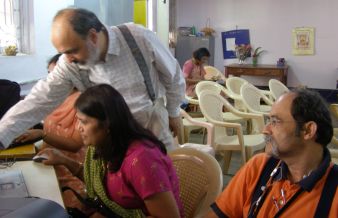
Given diverse kinds of disability, even within autism, cerebral palsy and dyslexia, and the different ways in which children might wish to use computers, there is an ongoing need to keep adding modules, and finding imaginative new ways to combine them. To address this need, the Skid initiative invites college students who know a little programming to undergo free of cost summer training in which they write software that doesn't just gather dust, but is put onto the web. Not only do they have the satisfaction that thousands of kids from around the world are benefiting from what they wrote, they also receive public credit on the page they helped design. ===================================================================
Dr. Arun Mehta has a B.Tech from IIT Delhi (1975), a Masters from SUNY Stonybrook, USA, and a PhD from Ruhr University, Germany. At the request of Professor Stephen Hawking, he wrote eLocutor, free and open source software that allows severely disabled people to write and speak. He volunteers as a programming instructor at the National Association for the Blind. In 2000, he co-founded Radiophony.com with IIT batchmate Vickram Crishna. Their current passion is software that might make communication easier for children with autism, cerebral palsy and dyslexia.
Sunday, October 05, 2008
TN Gives Reason to Cheer and Cause for Hope
The Government of India launched the Sarva Shikhsha Abhiyan (Education for All) program in 2003. I remember the launch as it came soon after I had concluded a research project at the behest of the Center for International Development at Harvard U, which was essentially a pilot study on the state of primary education in the vastly different districts of Madurai and Villupuram in Tamil Nadu. While there were some surprise findings in the study, much was as expected - a dismal state of education suffering from chronic issues like high drop-out rates, poor quality of teachers and teaching, and lack of adequate infrastructure.
Much hope has been reposed in Sarva Shiksha Abhiyan (SSA) since its launch. It is Government of India's mammoth, flagship programme "for achievement of Universalization of Elementary Education (UEE) in a time bound manner, as mandated by 86th amendment to the Constitution of India making free and compulsory Education to the Children of 6-14 years age group, a Fundamental Right.
SSA is being implemented in partnership with State Governments to cover the entire country and address the needs of 192 million children in 1.1 million habitations"
SSA's ambitions notwithstanding, most of us in India are painfully aware that the country, unfortunately, has a very long way to go still before it can boast universal education for all, and those chronic issues mentioned above still continue to plague the system. The pedagogy too, sadly, is still largely textbook-driven rote learning that rewards rote memorization and does not nurture understanding or questioning.
It was therefore a very pleasant surprise to come across a couple of videos - on YouTube, no less, that describe in detail an innovative pedagogy called Active Learning Methodology (ALM). ALM, which was designed as part of the outreach activities of the Krishnamurti Foundation School in Chennai, is based on research on brain-based learning and is being implemented as part of the SSA scheme in schools across Tamil Nadu. The videos are well made and provide some very good, concrete ideas to any teacher who wishes to employ an "active learning" pedagogy in a largely textbook-driven classroom environment (as is the case in much of India). The visuals are heart-warming - focusing as they do on female students - a demographic that is often deprived of an education in many parts of India.
There are other pointers too that Tamil Nadu seems to be doing well with their implementation of the SSA. TN certainly gives cause for cheer and hope - and a lesson for other states in the country.
Here are the 2 videos on the "Active Learning Methology" being employed by SSA teachers in TN...
Much hope has been reposed in Sarva Shiksha Abhiyan (SSA) since its launch. It is Government of India's mammoth, flagship programme "for achievement of Universalization of Elementary Education (UEE) in a time bound manner, as mandated by 86th amendment to the Constitution of India making free and compulsory Education to the Children of 6-14 years age group, a Fundamental Right.
SSA is being implemented in partnership with State Governments to cover the entire country and address the needs of 192 million children in 1.1 million habitations"
SSA's ambitions notwithstanding, most of us in India are painfully aware that the country, unfortunately, has a very long way to go still before it can boast universal education for all, and those chronic issues mentioned above still continue to plague the system. The pedagogy too, sadly, is still largely textbook-driven rote learning that rewards rote memorization and does not nurture understanding or questioning.
It was therefore a very pleasant surprise to come across a couple of videos - on YouTube, no less, that describe in detail an innovative pedagogy called Active Learning Methodology (ALM). ALM, which was designed as part of the outreach activities of the Krishnamurti Foundation School in Chennai, is based on research on brain-based learning and is being implemented as part of the SSA scheme in schools across Tamil Nadu. The videos are well made and provide some very good, concrete ideas to any teacher who wishes to employ an "active learning" pedagogy in a largely textbook-driven classroom environment (as is the case in much of India). The visuals are heart-warming - focusing as they do on female students - a demographic that is often deprived of an education in many parts of India.
There are other pointers too that Tamil Nadu seems to be doing well with their implementation of the SSA. TN certainly gives cause for cheer and hope - and a lesson for other states in the country.
Here are the 2 videos on the "Active Learning Methology" being employed by SSA teachers in TN...
Wednesday, September 10, 2008
Think Different (courtesy Apple)
Just love this video! I don't necessarily agree with their choice of people in the video - but I guess this was made for American audiences. The words and the message, however, are simply brilliant! Truly inspiring stuff...
Tuesday, September 09, 2008
Cool Science
If you want to get an idea of what the (Large Hadron Collider (LHC) experiment is all about - I've found this basic intro on Alice, CMS, Altas, LHCb and the Grid to be very well presented and organized.
Here's "Rock-star physicist" Brian Cox explaining the LHC on TED.
Prophecies of doom notwithstanding, this certainly sounds like a very exciting experiment - a hugely collaborative effort that will hopefully unlock some of the dark secrets of the universe. Here's the coolest science video I've come across :)
And if you want to get really spooked, check this one out...
But after that watch this one to be reassured - "YOU WON'T FEEL A THING!"
Here's "Rock-star physicist" Brian Cox explaining the LHC on TED.
Prophecies of doom notwithstanding, this certainly sounds like a very exciting experiment - a hugely collaborative effort that will hopefully unlock some of the dark secrets of the universe. Here's the coolest science video I've come across :)
And if you want to get really spooked, check this one out...
But after that watch this one to be reassured - "YOU WON'T FEEL A THING!"
Monday, September 08, 2008
Why do School Curricula Ignore the History of Computing and the Internet?
I was struck by this question at a recent visit to the Computer History Museum (CHM) in Mountain View, CA. Kitty-corner from the famed headquarters of Google in Mt. View, this museum currently proudly houses the Charles Babbage Difference Engine in addition to countless other artifacts that help the visitor trace the timeline of computer history and are a testimony to human ingenuity and inventiveness in the field of digital technologies through the last 6 or so decades.
The 2 hours my sons and I spent tracing the history of computers and computing (and the Internet to lesser extent) were mesmerizing - not just for me but my sons (aged 12 and 9) as well. There is obviously that thrill of watching the sizes (and prices) of computers go down as their computing power and storage capabilities shoot up exponentially; but the stories behind the early innovations are fascinating as well. (I think the kicks I got may have had a little to do with the fact that I have programmed the DEC VAX in my early days as a programmer and used the PDP-11 in my undergrad days at BITS, Pilani. The sight of punch cards brought back waves of long-forgotten memories - of their use as flashcards for memorizing GRE word lists :))
(Incidentally there are several awesome videos on the history of computers on CHM's channel on youtube).
I was reminded of my question once again yesterday when I chanced on a video of Ethan Zuckerman explaining the history of the Internet in about 5 mins - see below. (I think this one betters the earlier history of the Internet video I posted on this blog about half a year ago).
Agreed - the fact that I have always been fascinated by the history of Computers, Computing and the Internet may have a little to do with the fact that I have used computers for about 25 years now - I did my undergrad in Computer Science from BITS Pilani in the mid-eighties, and then was exposed to the Internet in the US in the BBS, usenet and gopher "pre-browser" days of the early 90s. (I remember following the 1992 Cricket World Cup sitting in my little apartment in the US - ball-by-ball on rec.sport.cricket. Why I was a member of rec.sports.gymn in 1991-92 I have no clue!).
That said, given how pervasive these machines are in our lives today, I think everyone, and kids especially, would be just as fascinated by the history of how computing, computers and the internet crept into our lives - starting with the code breakers used by governments during WWII; the work of research universities such as MIT; DARPA; the big mainframes; the pioneering work of organizations such as IBM; the birth of personal computers; Microsoft, Apple; supercomputers (the slideshow above has some pictures of the Cray as well); and finally CERN, hypertext, the World Wide Web and Google; iPods; video games; and seemingly limitless data storage capabilities...
Children are taught about many important discoveries, inventions and innovations in the course of their regular curriculum in Science and Social Studies. The rationale being that history teaches us about what man has done and thus what man is; and also helps kids understand change and societal development. Computers, Computing, the Internet and the World Wide Web rarely ever get the billing they deserve in school curricula today, despite that fact that these kids' lives are so hugely influenced by the use of computers and the Internet. I am convinced that our kids who are so familiar with names like Microsoft, Apple, Intel, Google, Yahoo, Sun (to a lesser extent), Bill Gates, Steve Jobs, Larry Page and Sergei Brin; so familiar with the idea of computers and with the use of computers deserve to know and be aware about innovations in computers, the evolution of these technologies, and the people and organizations that laid the foundation for the work of Gates, Jobs, Page and Brin.
And while they're at it, I think they should also learn the basics of boolean logic, binary number systems and why silicon valley is christened thus :)
Anyway, here's Ethan Zuckerman's entertaining video on the History of the Internet...Enjoy!
The 2 hours my sons and I spent tracing the history of computers and computing (and the Internet to lesser extent) were mesmerizing - not just for me but my sons (aged 12 and 9) as well. There is obviously that thrill of watching the sizes (and prices) of computers go down as their computing power and storage capabilities shoot up exponentially; but the stories behind the early innovations are fascinating as well. (I think the kicks I got may have had a little to do with the fact that I have programmed the DEC VAX in my early days as a programmer and used the PDP-11 in my undergrad days at BITS, Pilani. The sight of punch cards brought back waves of long-forgotten memories - of their use as flashcards for memorizing GRE word lists :))
(Incidentally there are several awesome videos on the history of computers on CHM's channel on youtube).
I was reminded of my question once again yesterday when I chanced on a video of Ethan Zuckerman explaining the history of the Internet in about 5 mins - see below. (I think this one betters the earlier history of the Internet video I posted on this blog about half a year ago).
Agreed - the fact that I have always been fascinated by the history of Computers, Computing and the Internet may have a little to do with the fact that I have used computers for about 25 years now - I did my undergrad in Computer Science from BITS Pilani in the mid-eighties, and then was exposed to the Internet in the US in the BBS, usenet and gopher "pre-browser" days of the early 90s. (I remember following the 1992 Cricket World Cup sitting in my little apartment in the US - ball-by-ball on rec.sport.cricket. Why I was a member of rec.sports.gymn in 1991-92 I have no clue!).
That said, given how pervasive these machines are in our lives today, I think everyone, and kids especially, would be just as fascinated by the history of how computing, computers and the internet crept into our lives - starting with the code breakers used by governments during WWII; the work of research universities such as MIT; DARPA; the big mainframes; the pioneering work of organizations such as IBM; the birth of personal computers; Microsoft, Apple; supercomputers (the slideshow above has some pictures of the Cray as well); and finally CERN, hypertext, the World Wide Web and Google; iPods; video games; and seemingly limitless data storage capabilities...
Children are taught about many important discoveries, inventions and innovations in the course of their regular curriculum in Science and Social Studies. The rationale being that history teaches us about what man has done and thus what man is; and also helps kids understand change and societal development. Computers, Computing, the Internet and the World Wide Web rarely ever get the billing they deserve in school curricula today, despite that fact that these kids' lives are so hugely influenced by the use of computers and the Internet. I am convinced that our kids who are so familiar with names like Microsoft, Apple, Intel, Google, Yahoo, Sun (to a lesser extent), Bill Gates, Steve Jobs, Larry Page and Sergei Brin; so familiar with the idea of computers and with the use of computers deserve to know and be aware about innovations in computers, the evolution of these technologies, and the people and organizations that laid the foundation for the work of Gates, Jobs, Page and Brin.
And while they're at it, I think they should also learn the basics of boolean logic, binary number systems and why silicon valley is christened thus :)
Anyway, here's Ethan Zuckerman's entertaining video on the History of the Internet...Enjoy!
Wednesday, September 03, 2008
Listen to the Digital Natives, Sync Up With Your iKids
 Purely by coincidence, the day after I wrote the post on Marc Prensky and Born Digital, I came across an article by Prensky which appeared as the cover story of Edutopia some weeks ago. The story is titled "Young Minds, Fast Times: The Twenty-First-Century Digital Learner: How tech-obsessed iKids would improve our schools." I believe that at the core of this issue is again the idea of digital natives and digital immigrants that I talked about in the previous post.
The article to me is less about what kids would like their school education to look like, than about the simple but so very important act of listening to kids; and not just about what they feel about their learning and how they would like to learn, but everything that concerns them and their lives. It seems so ironical that we attempt to shape our kids into responsible, questioning, independent-thinking human beings, but do not allow them to question or have a say in how they would like to learn and be taught; about how they would like to spend those countless hours in the classroom through those dozen odd years that we keep them in school.
If you did ask, you'd find out that kids of today are BORED, BORED, BORED by plain old chalk and talk (See some quotes below from the article). Think about how they spend their time outside the classroom and during their vacations, and contrast that with how we expect them to sit - hour after hour and day after day in the classroom - with none of the technology that they are so fluent and happy with outside of school - listening to teachers who are so clueless about how to engage them. Can we blame them if they find most of their classes mind-numbingly boring and have this to say ? --
"I'm bored 99 percent of the time."
"School is really, really boring."
"We are so bored."
"Engage us more."
"[My teachers] bore me so much I don't pay attention."
"Pointless. I'm engaged in two out of my seven classes."
Prensky calls "unacceptable and untenable" the fact that "Unlike in the corporate world, where businesses spend tens of millions researching what their consumers really want, when it comes to how we structure and organize our kids' education, we generally don't make the slightest attempt to listen to, or even care, what students think about how they are taught.", and he likens this to the treatment of women before suffrage.
According to the article - "Students universally tell us they prefer dealing with questions rather than answers, sharing their opinions, participating in group projects, working with real-world issues and people, and having teachers who talk to them as equals rather than as inferiors. Hopefully, this is useful information for teachers and other educators -- and it is important that educators realize just how universal these opinions are."
Prensky concludes the article with -- "After hosting dozens of these conversations, I realize one thing: We just don't listen enough to our students. The tradition in education has been not to ask the students what they think or want, but rather for adult educators to design the system and curriculum by themselves, using their "superior" knowledge and experience.
But this approach no longer works. Not that the inmates should run the asylum, but as twenty-first-century leaders in business, politics, and even the military are finding out, for any system to work successfully in these times, we must combine top-down directives with bottom-up input. As the students have told me on more than one occasion, "We hope educators take our opinions into account and actually do something!" Until we do, their education will not be the best we can offer."
Subscribe to:
Posts (Atom)