Finally got around to conducting the workshop on 'Internet Use in Schools' described in my previous post. It was a "huge hit" (those are a participant's words - but I would have said something similar anyway - one does have a sense for how things have gone down in a workshop.)
Thirty teachers - mostly from elementary school - attended. While they learnt a lot more about google and how it works, gained a good sense for what children below 11-12 years of age are - and are not - capable of in terms of information-gathering from the Internet, as well as issues of 'copy-pasting' and child safety, it was the new tool Trackstar, that I introduced to them, was truly the star of the event. The tool allows a teacher to create a "track" of websites (that s/he would typically have identified prior to, or during, a unit) along with annotations(questions/notes or things for students to keep in mind). The track number is all that the students then need to go to the web page (at home or in school) that contains all the websites (along with annotations) - that come up as frames within the Trackstar site. Safe and productive, especially for elementary school students.
The section on kid safety on the Internet was an eye-opener for teachers. One of them asked me to have a session on this subject in June with the parents of her incoming 6th grade class. The teachers also agreed to make 'OneKey' - the kidsafe version of google that I made them try out - the homepage for all computers in the school labs. I have also decided to make a "Search" link on the IE toolbars in school that will link to 'onekey'.
An 'inspired' science teacher wrote me the same evening about having created a "track" for her 7th grade students, on the topic of environmental science. Felt good to get that email - felt like I had accomplished something that day...

Wednesday, April 19, 2006

Sunday, April 16, 2006
Google Page Creator (GPC) - Arrgghhh!
So I was supposed to conduct this workshop last Thursday (April 13th) for teachers on "Searching on the Internet". Teachers (like everyone else) are increasingly searching (or rather google-ing) the Internet for information on topics related to the curriculum (as they should) and expecting kids as young as 7 and 8 years old to do the same - notwithstanding the fact that good searching requires some higher order thinking skills and a level of general awareness that makes it difficult for young kids to pull it off without adult help. The focus of this workshop was to be on --
- how to conduct better searches (handy tips on coming up with good keywords based on how Google works),
- how to scaffold the process of information gathering for elementary school children (using Trackstar, or del.icio.us or plain ol' bookmark folders in the classroom computers),
- critical evaluation of websites (making it a conscious process for the naive user - as well as kids - until practice and more awareness makes it the intuitive process it is for many of us),
- plagiarism (many kids do not even realize that they may be committing a wrong-doing by extensively cutting-and-pasting to prepare a report!), and
- child safety on the Internet (if you're going to let them loose in this deep, dark forest, know that there are bad wolves lurking behind many a tree - parents and teachers in India are abominably clueless!)
So, what does GPC have to do with all of this? Well, crazed fans of Rajkumar ('demigod' filmstar) in Bangalore made sure that the workshop be postponed and roughly 36 hours on Wednesday & Thursday be spent completely locked up indoors (esp. if you live a couple of streets away from Rajkumar's residence like I do). Putting up a website with the newly approved 'googlepages' account seemed like a great way to spend time - and one that would finally be a 'home' for the nearly 100 pictures from my Robotics club sessions, certainly a very worthwhile cause as well. Late last night (Saturday, April 15th), I finished publishing this plain-jane website comprising only 8 pages.
So, what transpired in between Thursday and Saturday? An unspeakably frustrating (pulling teeth…?) experience with Google Page Creator. Without ranting in too much detail I will just say that this terribly buggy piece of software (yeah! yeah! I know it's a beta version) that allows you so little flexibility in designing your website, is a blot in Google's product suite. If I weren't so pig-headed about sorting and putting up these pictures that I'd been promising my Robotics students for years, I'd have actually felt good about abandoning the project! 100 MB of ad-free space on the google server for a website plus 100 file uploads (I even uploaded some other images for access on some other sites) is tempting, but waiting for a better version of this software would be not be un-smart at all.
While painfully perservering through the entire website creation process, I often wondered about the intended user profile from Google's viewpoint. I could think of no one other than young school kids - my 7-year old son was ecstatic when he was able to put up his very own website in about 1/2 an hour!
Well, the site is up (phew!) – and I think I deserve another 36 hours (not necessarily cooped up indoors) to recover…..!
Friday, April 14, 2006
Innovation!

(Disclaimer: Though this does not relate very directly to issues of Technology & Education, if you try hard, you could draw some tangential links [smile]).
While on the subject of creativity, thought I'd devote a few bits n bytes to its close friend 'Innovation' .
The cover story of the latest issue of Business Week is about the World's Most Innovative Companies. (The rest of the issue also dedicates much real estate to the subject of Innovation.) The usual suspects all made the cut - Google, Apple, IBM, Starbucks...
Funnily though, while the main story states that (unlike in the 1990s) "Innovation (today) does not have to have anything to do with technology", most of the products/ideas that featured in the slide-show of innovations (about 16 out of 25) had much to do with technology!
Open Innovation is a big theme that is being talked about and touted as the way to go. "These days the world is your R&D lab. Customers are co-opting technology and morphing products into their own inventions. Many companies are scouting for outside ideas they can develop in-house, embracing the open-source movement, and joining up with suppliers or even competitors on big projects that will make them more efficient and more powerful."
Interestingly, according to the article, India (at par with China) is being viewed as a major "source" of innovation and companies are looking to set up product development centers here. So, how should schools produce and prepare this generation of Indian innovators that the world is pinning its hopes on? "Teaching for creativity" (as opposed to "creative teaching") might well have some answers - instilling in our students that skill of possibility thinking ...
Tuesday, April 11, 2006
Oh! The Joy of a Good Read
I’m currently reading “Creativity in Schools” by Anna Craft (Routledge, 2005). Creative Learning = “Possibility Thinking” has been the big take-away for me thus far, as also the fine but pertinent differences between ‘teaching creatively’, ‘teaching for creativity’, and ‘creative learning’. While the role of technology in creative teaching and learning has been touched upon only cursorily, it is what I am constantly trying to make links with, as I go through this topical discourse on creativity in schools.
While I reserve further comment on the book until I have gone through it in its entirety, I will say this – I found the foreword by Tim Smit (of the Eden Project in the UK) to be such a beautifully crafted piece of writing. His delectably cynical and unabashedly candid take on creativity in general (and not specifically in the context of education) was an unmitigated pleasure to read. Here’s a sampling…
“Creativity is a word that comes with baggage. In some circles it hints at genius, in others to dodgy accounting practices. Being creative is either praise or an inference of a character flaw. However it is used, the implication is that some kind of cleverness is involved…Most of us are suspicious of it being the Devil’s work unless it is done in the name of a greater good, in which case divine intervention bestows cod sanctity to the practitioner. Latterly, as it has become part of the educator’s armoury, it has taken on a new meaning. It is something we all have, if only we could draw it out of ourselves. … We’re all creative now, and this robs it of its exclusive sting.”
“My youngest son once said in jest that he wished I’d been an abusive father so that he could be a credibly creative musician. All of us know that, by and large, this is a stereotype that doesn’t bear very close inspection, but that there is a grain of truth in it. This is evidenced in part in our culture by awarding artists more latitude in behaviour than we would allow others. There is a wonderful irony that we will celebrate artists to whom we wouldn’t give houseroom on a personal level.”
While I reserve further comment on the book until I have gone through it in its entirety, I will say this – I found the foreword by Tim Smit (of the Eden Project in the UK) to be such a beautifully crafted piece of writing. His delectably cynical and unabashedly candid take on creativity in general (and not specifically in the context of education) was an unmitigated pleasure to read. Here’s a sampling…
“Creativity is a word that comes with baggage. In some circles it hints at genius, in others to dodgy accounting practices. Being creative is either praise or an inference of a character flaw. However it is used, the implication is that some kind of cleverness is involved…Most of us are suspicious of it being the Devil’s work unless it is done in the name of a greater good, in which case divine intervention bestows cod sanctity to the practitioner. Latterly, as it has become part of the educator’s armoury, it has taken on a new meaning. It is something we all have, if only we could draw it out of ourselves. … We’re all creative now, and this robs it of its exclusive sting.”
“My youngest son once said in jest that he wished I’d been an abusive father so that he could be a credibly creative musician. All of us know that, by and large, this is a stereotype that doesn’t bear very close inspection, but that there is a grain of truth in it. This is evidenced in part in our culture by awarding artists more latitude in behaviour than we would allow others. There is a wonderful irony that we will celebrate artists to whom we wouldn’t give houseroom on a personal level.”
Thursday, April 06, 2006
More of the same...
It's been a couple of weeks since my last post but I've found my thoughts straying back (on more than one occasion) to the issue mentioned in the last posting - that of the burgeoning new web tools that are emerging at speeds too fast for us to keep up, and in the process leaving far far behind the majority of schools in India that are still only awakening (or still oblivious) to the possibilities of the internet.
The Hindu carried an article earlier this week on Cool classroom tools that discussed the phenomenon of podcasting, its use in education and the Duke Digital Initiative as a case in point. Would I come across as too much of a cynic if I said that there is little point in even running such an article in India? "...A school or college in India (reaching out) to its students in a new meaningful and cool way and (creating) a whole new educational iPod lifestyle." Give me a break! The very idea of students and teachers creating audio and video content for streaming onto portable devices just seems light years away in any educational setting in India - heck! even the use of regular audio and video remain untapped technologies in classrooms here! (May I add though that I would, of course, be thrilled to bits if some school in India actually took podcasting for a whirl...)
For more on emerging technologies in education, sans the attendant pessimism and cynicism that have marked my recent ramblings, visit the course website for T561 (Emerging Educational Technologies) being offered at HGSE this Spring by good ole' Prof. Chris Dede (who I was fortunate to have as my Advisor for my Masters) - a true "tech in ed" visionary esp. with respect to technologies that "bridge distance and time." Topics include podcasting, MUVEs, Social Networking, Collaborative Synchronous and Asynchronous Learning Environments and a host of other fun stuff.
And with that I lay this theme to rest (at least for now) and move on to other (less depressing?) topics.
I think I will turn my attention to sharing some insights gleaned from my recent experiences in developing a Technology Plan for a school - a very worthwhile activity that I am quite sure few schools in India engage in...[wry smile]... or perhaps my thoughts on GIS that I am working (with the Geography and Environmental Science teachers and a local GIS SIG) to introduce in the MAIS middle/high school curriculum.
(Think I should change the tagline of this blog to "Musings of a US-educated Indian Cynic"?)
The Hindu carried an article earlier this week on Cool classroom tools that discussed the phenomenon of podcasting, its use in education and the Duke Digital Initiative as a case in point. Would I come across as too much of a cynic if I said that there is little point in even running such an article in India? "...A school or college in India (reaching out) to its students in a new meaningful and cool way and (creating) a whole new educational iPod lifestyle." Give me a break! The very idea of students and teachers creating audio and video content for streaming onto portable devices just seems light years away in any educational setting in India - heck! even the use of regular audio and video remain untapped technologies in classrooms here! (May I add though that I would, of course, be thrilled to bits if some school in India actually took podcasting for a whirl...)
For more on emerging technologies in education, sans the attendant pessimism and cynicism that have marked my recent ramblings, visit the course website for T561 (Emerging Educational Technologies) being offered at HGSE this Spring by good ole' Prof. Chris Dede (who I was fortunate to have as my Advisor for my Masters) - a true "tech in ed" visionary esp. with respect to technologies that "bridge distance and time." Topics include podcasting, MUVEs, Social Networking, Collaborative Synchronous and Asynchronous Learning Environments and a host of other fun stuff.
And with that I lay this theme to rest (at least for now) and move on to other (less depressing?) topics.
I think I will turn my attention to sharing some insights gleaned from my recent experiences in developing a Technology Plan for a school - a very worthwhile activity that I am quite sure few schools in India engage in...[wry smile]... or perhaps my thoughts on GIS that I am working (with the Geography and Environmental Science teachers and a local GIS SIG) to introduce in the MAIS middle/high school curriculum.
(Think I should change the tagline of this blog to "Musings of a US-educated Indian Cynic"?)
Tuesday, March 21, 2006
Of Folksonomies, Blogospheres, Tag Clouds...and Education
Read an article recently - Web 2.0: A New Wave of Innovation for Teaching and Learning? in the March/April 2006 issue of Educause Review. The article, which was mostly a descriptive account of the emergent “social software” and tools that justify the 2.0 in the moniker 'Web 2.0', fell somewhat short in its analysis of how these would lead to innovative teaching and learning, other than mentioning the obvious affordances of the read-write web in collaborative projects in higher ed.
Reading the article left me a bit depressed – this emerging new web paradigm is progressing too fast (even by Web standards, according to the article) for us to keep pace. The education community in India has barely tapped the enormous potential of the old web (Web 1.0, if you will). There are enough tools for collaboration even in our familiar Worldwide Web of old. How many teachers here are using even easy-to-setup-and-use e-groups or wikis or even email for telementoring or collaborative projects? How many have even heard of Webquests? Why are urban schools with email-savvy teaching staff that has access to the internet not using the affordances of the internet for communication (a la corporate houses)? In this world, RSS probably means little more than Rashtriya Swayamsevak Sangh!
It is not my intention to suggest that it is mandatory that every available technology be used by every educator. But what stops a teacher from exploring these new tools that don’t cost anyone anything other than some time and effort? While some of these do require a cursory understanding of xml and html, simple blogging and social bookmarking tools such as del.icio.us don’t. To me all this again points to the lack of digital fluency among the majority of our teaching population as well as a dearth of educational technologists who can help teachers stay abreast of tech advances and even aid teachers in such explorations (ref. my post on Enabling Conditions for Successful Technology Use).
If the aim of every good teacher and school today is to prepare children for the 21st century, are they not obligated to provide these children with exposure to the new paradigms of interactions – and the openness and social quality that are the hallmark of collaborative work in this century?
Reading the article left me a bit depressed – this emerging new web paradigm is progressing too fast (even by Web standards, according to the article) for us to keep pace. The education community in India has barely tapped the enormous potential of the old web (Web 1.0, if you will). There are enough tools for collaboration even in our familiar Worldwide Web of old. How many teachers here are using even easy-to-setup-and-use e-groups or wikis or even email for telementoring or collaborative projects? How many have even heard of Webquests? Why are urban schools with email-savvy teaching staff that has access to the internet not using the affordances of the internet for communication (a la corporate houses)? In this world, RSS probably means little more than Rashtriya Swayamsevak Sangh!
It is not my intention to suggest that it is mandatory that every available technology be used by every educator. But what stops a teacher from exploring these new tools that don’t cost anyone anything other than some time and effort? While some of these do require a cursory understanding of xml and html, simple blogging and social bookmarking tools such as del.icio.us don’t. To me all this again points to the lack of digital fluency among the majority of our teaching population as well as a dearth of educational technologists who can help teachers stay abreast of tech advances and even aid teachers in such explorations (ref. my post on Enabling Conditions for Successful Technology Use).
If the aim of every good teacher and school today is to prepare children for the 21st century, are they not obligated to provide these children with exposure to the new paradigms of interactions – and the openness and social quality that are the hallmark of collaborative work in this century?
Friday, March 17, 2006
Weblogg-ed
No conversation about blogs in education is complete without at least a mention of the blog dedicated solely to the subject - Weblogg-ed.
Other sites worthy of note - edublogs.org - for setting up free blogs on education.
Schoolblogs, also a free service for educational blogs and set up on the Manila platform, has great features (a discussion board for asynchronous threaded discussions, and the ability to upload files & links), but it seems to be plagued by technical issues - it is slow and downtimes are frequent. (I even set up the PPSE group blog and "bulletin board" there at first, but we had to abandon it due to these recurring technical problems).
Other sites worthy of note - edublogs.org - for setting up free blogs on education.
Schoolblogs, also a free service for educational blogs and set up on the Manila platform, has great features (a discussion board for asynchronous threaded discussions, and the ability to upload files & links), but it seems to be plagued by technical issues - it is slow and downtimes are frequent. (I even set up the PPSE group blog and "bulletin board" there at first, but we had to abandon it due to these recurring technical problems).
Blogging in the Classroom (...not literally!) / Blogging Teachers
A comment on a post here touched on the issue of blogs in education – something I’ve given much thought to over the last year or so. Much has been written about the benefits of blogs especially in the context of K-12 education – mostly ideas around publishing and collaborative learning, facilitated by the ease of setup and use of this tool. The last couple of years have seen a phenomenal rise in the use of blogs in the classroom in the US.
[In keeping my with firm beliefs in first making teachers aware and fluent in the technology we would like them to use], I do think that we cannot expect teachers to design curriculum around blogs unless they’ve experienced blogging first-hand. So teacher awareness about the world of blogs one of the goals I set out to achieve this past year.
Educational Blogging (an article that appeared in the Sept/Oct 2004 issue of Educause) was one of the earlier writings on this subject. It was this article that I distributed to a group of teachers that I work with (at MAIS, Bangalore) as an introduction to the world of blogging in education. As part of the team that was facilitating a teacher professional development program (called Professional Practice and Studies in Education, or PPSE) for these teachers, and designing their coursework, I worked the use of blogs into their PD curriculum – having them reflect on their teaching practice or any other specified topic, on their personal blogs that I helped them set up. (I think a teacher’s blog could serve well as his/her e-portfolio too). I also set up a group blog that would operate as a common platform for discourse on education, or even just for announcements and general communication among the group.
Some of these efforts were also aimed at building a community of practice (CoP). Teaching is known to be (to a large extext) a solitary activity and we wanted to set up modes of communication that would alleviate some of the isolation teachers experience in their profession.
As was expected, some of the 21 teachers who are part of the PPSE program took to blogging more easily than others. All in all, it's been a rewarding experience. The fact that some teachers have started blogs for their subjects with their students is icing on the proverbial cake. Mission Accomplished!!!
(Unfortunately in a country such as ours, hesitancy in written communication in English can be a huge stumbling block in such an endeavor even for some teachers in urban English-medium schools such as 2nd and 3rd language teachers. Will save that for a later discussion…)
[In keeping my with firm beliefs in first making teachers aware and fluent in the technology we would like them to use], I do think that we cannot expect teachers to design curriculum around blogs unless they’ve experienced blogging first-hand. So teacher awareness about the world of blogs one of the goals I set out to achieve this past year.
Educational Blogging (an article that appeared in the Sept/Oct 2004 issue of Educause) was one of the earlier writings on this subject. It was this article that I distributed to a group of teachers that I work with (at MAIS, Bangalore) as an introduction to the world of blogging in education. As part of the team that was facilitating a teacher professional development program (called Professional Practice and Studies in Education, or PPSE) for these teachers, and designing their coursework, I worked the use of blogs into their PD curriculum – having them reflect on their teaching practice or any other specified topic, on their personal blogs that I helped them set up. (I think a teacher’s blog could serve well as his/her e-portfolio too). I also set up a group blog that would operate as a common platform for discourse on education, or even just for announcements and general communication among the group.
Some of these efforts were also aimed at building a community of practice (CoP). Teaching is known to be (to a large extext) a solitary activity and we wanted to set up modes of communication that would alleviate some of the isolation teachers experience in their profession.
As was expected, some of the 21 teachers who are part of the PPSE program took to blogging more easily than others. All in all, it's been a rewarding experience. The fact that some teachers have started blogs for their subjects with their students is icing on the proverbial cake. Mission Accomplished!!!
(Unfortunately in a country such as ours, hesitancy in written communication in English can be a huge stumbling block in such an endeavor even for some teachers in urban English-medium schools such as 2nd and 3rd language teachers. Will save that for a later discussion…)
Tuesday, March 14, 2006
iDiscoveri Ed Offerings
While on the subject of quality education for educators in India --
iDiscoveri is also launching 2 Post-Graduate Diploma programs (*note* in India 'undergraduate' is refered to as 'graduate' and 'graduate' as 'post-graduate') - one in Innovative Teaching and one in Educational Leadership.
The organization has grown to be a force to reckon with and is certainly living its vision of reviving education in India. (Incidentally, the CEO and one program head were in my Ed.M. class at Harvard Graduate School of Education in 2001-2002). The PG courses on education are obviously in answer to the crying need for such programs in India.
Unfortunately, none of these new programs have any course offerings on the use of technology in education. It's time for someone to wake up to that reality and address that need as well - I'll be happy to offer my services to the cause...
iDiscoveri is also launching 2 Post-Graduate Diploma programs (*note* in India 'undergraduate' is refered to as 'graduate' and 'graduate' as 'post-graduate') - one in Innovative Teaching and one in Educational Leadership.
The organization has grown to be a force to reckon with and is certainly living its vision of reviving education in India. (Incidentally, the CEO and one program head were in my Ed.M. class at Harvard Graduate School of Education in 2001-2002). The PG courses on education are obviously in answer to the crying need for such programs in India.
Unfortunately, none of these new programs have any course offerings on the use of technology in education. It's time for someone to wake up to that reality and address that need as well - I'll be happy to offer my services to the cause...
Monday, March 13, 2006
Hands-on Learning
Talking about the "hands-on" learning at The Tech in an earlier post reminded me of a picture taken at a session of the Robotics Club @ Aditi which I run for high school kids at Mallya Aditi International School, Bangalore.
This one's a personal favorite - quite literally "hands-on" learning! The Robotics Club sessions are fun! Learning is incidental...

This one's a personal favorite - quite literally "hands-on" learning! The Robotics Club sessions are fun! Learning is incidental...
Masters in Education at TISS
A recent article in the Deccan Herald with Dr Padma Sarangapani's comments on the new M.A. in Education refered to in my previous post.
Sunday, March 12, 2006
Education - A legitimate field of study?
The cover story of latest issue (March 19) of The Week is "Best Degrees" with President Kalam's "exclusive" on The Mission of Education. The irony is that Education itself does not feature anywhere in the surveys as a program of study in India - not in the undergraduate or graduate degrees; not even as a diploma program where courses such as 'Technical Writing', 'Digital Designing', 'Hotel Management', 'Fashion Technology', 'Medical Laboratory Technology' and 'Nursing' make the cut. Is it even considered a legitimate field of study in India?
Dr. Kalam has obviously given much thought to several issues that plague the system of education in the country and he has suggested several workable solutions that policymakers would do well to pay heed to. But when the President waxes eloquent about the what could and should be done to lay the "foundation for best students and best degrees...in pre-primary, primary and secondary education" does he or anyone else stop to think how the nation is building its workforce of teachers, principals, administrators, policymakers and leaders in the field of education? Or are these all areas of expertise that do not merit any formal education and training? When he states that "the teacher has to be equipped with all the knowledge required for effective teaching", should he not also suggest bettering the lot of formal programs in teacher education?
With customary vision, the President espouses the benefits of leveraging technology in education. He commends the use of "computer aids" in Karnataka where children "have a creative learning with the tools of creative animation through the use of computers." He dedicates a whole paragraph to Technology Enhanced Education. His thrust is on using technology for distance learning and digital libraries. He anticipates falling prices of computers and communications bandwidth driving increased use of technology in education, and envisions "virtual classrooms of the future." Amen to that.
Much can be done in real classrooms and schools too, even today, with existing infrastructure - if only people decided to acquire some expertise in teaching - the kind of expertise that will come from engaging with the subject in an undergraduate program of worth, wrestling deeply with such issues at the graduate level, heck, even just becoming aware of them in a diploma course. The recently instituted Masters in Education at TISS (in collaboration with NIAS, Homi Bhabha Centre for Science Education, Eklavya, Vidya Bhawan Society, and Digantar) certainly gives reason to cheer...
Dr. Kalam has obviously given much thought to several issues that plague the system of education in the country and he has suggested several workable solutions that policymakers would do well to pay heed to. But when the President waxes eloquent about the what could and should be done to lay the "foundation for best students and best degrees...in pre-primary, primary and secondary education" does he or anyone else stop to think how the nation is building its workforce of teachers, principals, administrators, policymakers and leaders in the field of education? Or are these all areas of expertise that do not merit any formal education and training? When he states that "the teacher has to be equipped with all the knowledge required for effective teaching", should he not also suggest bettering the lot of formal programs in teacher education?
With customary vision, the President espouses the benefits of leveraging technology in education. He commends the use of "computer aids" in Karnataka where children "have a creative learning with the tools of creative animation through the use of computers." He dedicates a whole paragraph to Technology Enhanced Education. His thrust is on using technology for distance learning and digital libraries. He anticipates falling prices of computers and communications bandwidth driving increased use of technology in education, and envisions "virtual classrooms of the future." Amen to that.
Much can be done in real classrooms and schools too, even today, with existing infrastructure - if only people decided to acquire some expertise in teaching - the kind of expertise that will come from engaging with the subject in an undergraduate program of worth, wrestling deeply with such issues at the graduate level, heck, even just becoming aware of them in a diploma course. The recently instituted Masters in Education at TISS (in collaboration with NIAS, Homi Bhabha Centre for Science Education, Eklavya, Vidya Bhawan Society, and Digantar) certainly gives reason to cheer...
Exploratory Learning Environments
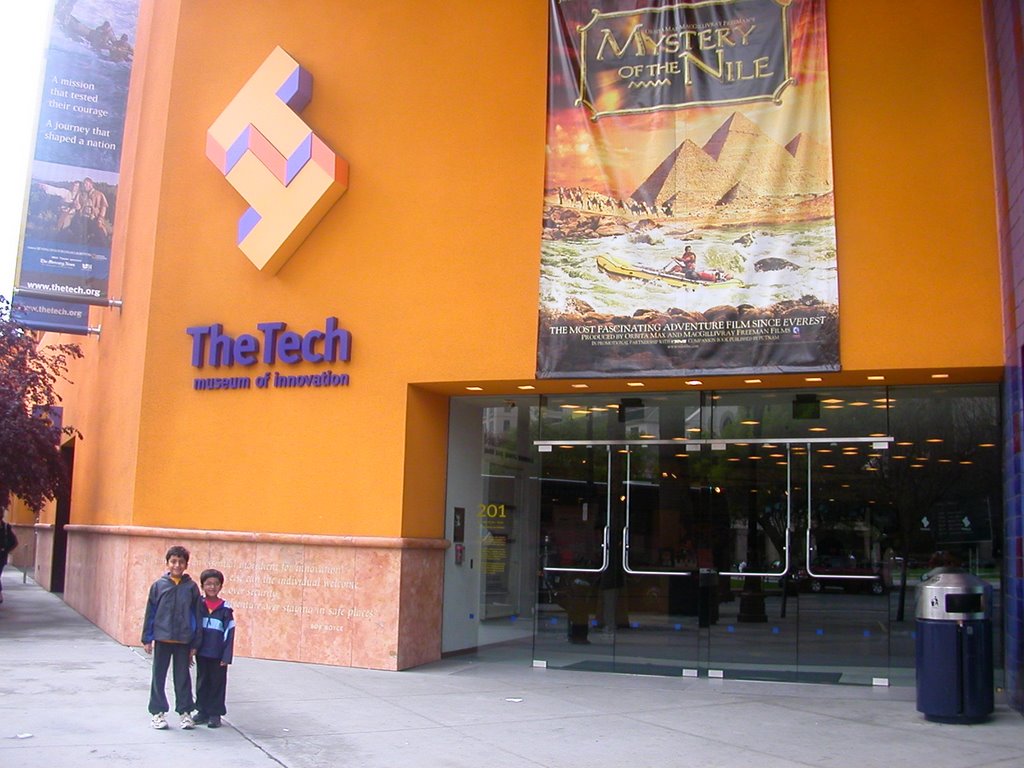 The Tech Museum of Innovation (popularly known simply as "The Tech") in San Jose is such a wonderful space that works to de-mystify the whole "technology" thing for kids (and interested adults as well). From visual representations of the boolean logic that drives circuits to chunks of silicon and the insides of all kinds of electronic components of computers and other gadgets that are all around us - kids can "see", "touch", "feel", "experience"...
Schools in the area leverage the presence of this fantastic informal learning environment and avail of the various events and activities that the Museum aims at schools. The Tech runs summer camps and also the hugely popular annual "Tech Challenge" for school kids.
This museum obviously benefits from being in the heart of Silicon Valley for ideas and artifacts. Why can we not have a similar space in India, in Bangalore - purportedly the "Silicon Valley" of India? There is no dearth of tech activity around here; sadly, there's just a dearth of good intent that will translate into action...

Hands-on and Interactive - A 'desi' explains the history of the silicon chip (left picture)
Wednesday, February 22, 2006
Enabling Conditions For Effective & Sustainable Technology Integration in Schools
Inspite of spending crores of rupees on building a technology infrastructure over the last decade, schools in India (private and government schools alike) have made woefully slow progress in leveraging these assets for better teaching and learning. Conscious observations of classrooms leave educators trained in technology integration wondering whether technology usage in its current form will have any impact on the realization of the universal objective of 21st century schooling - to create lifelong learners who are able to survive in today’s knowledge and creative economy. If the current practices continue, fast forward 5-10 years from now and what will we have? Either a bunch of disillusioned schools that will be unable to justify the enormous price-tag that accompanies ‘unproductive’ technology solutions, or a bunch of ill-advised schools that will continue to bumble through technology investments with no cognizance of how under-utilized their technology investments are.
With corporates such as Intel, HP and Microsoft (whose long-term fortunes directly correlate to PC penetration in schools) making commitments to the education sector, technology largesse and spending are poised to grow. Besides, the tech-savvy new generation of kids exposed to the ‘read & write’ web (web 2.0) and new media digital tools deserves an education that leverages this exposure and comfort with technology that they enjoy. Unless all the stakeholders involved become cognizant of certain ingredients that are needed within schools for sustainable & effective technology integration in the classrooms, all this effort and expense will not result in commensurate betterment of technology-enabled teaching & learning.
Much like Larry Cuban provided a reality-check of the state of technology in U.S. schools in the late-90’s (in his book Computers in the Classroom: Oversold and Underused), this article, based on a real, hard look at the current state of technology use in the Indian K-12 education, aims to detail some critical ingredients that are so critical to achieving durable success in this realm.
The suggestions presented here take the form of a set of enabling conditions that must be in place for schools to succeed in their goal of effective technology integration that is sustainable as well. A short-fall in any of these ingredients can and will result in inefficient, ill-conceived or even inappropriate use of technology.
What is heartening is that implementing these ‘enabling’ factors will cost a fraction of the typical capital technology investment. To implement these will not require a huge financial outlay. What it will require is for all parties concerned to be aware of these factors, budget any attendant expenses attached to implementing these as ‘operating expenses’ for incorporating technology in their schools, and attempt to ensure that these are all in place, most, if not all, of the time.
‘Enabling conditions’ for successful technology integration in schools -
- ‘Digital Fluency’ among Teachers or in other words, their comfort level with technology. How often have we seen teachers throw up their hands at a paper jam in a printer, or wonder about a ‘hung’ system (which is quite often the case when the system in question is Microsoft Windows), or call for help to connect a data projector to a computer?
All these point to a basic lack of comfort with computers. What is needed among teachers is not simply digital literacy, but digital fluency. Just as fluency with a language takes one beyond mere literacy and helps one understand the nuances of a language, digital fluency helps one handle the unexpected when it comes to technology – which, as it turns out, is quite often the case. This does not mean that teachers need to be trained computer professionals. It does mean that teachers should move beyond viewing the computer or any other piece of hardware as a mysterious object that only the very exalted can handle. They should be able to playfully explore a piece of technology (be it a digital camera or a new piece of software) without fear or intimidation. Unless they achieve this comfort level with technology, they will constantly be faced with situations where they have to abort a technology-based lesson due to a problem that they could have handled with some fearless ‘poking around’.
In today’s networked world, digital fluency also means teachers harness the power of technology (the internet in particular) for communications (email, blogs, e-groups) and productivity tasks, in addition to using technology in the classroom. - Good ‘educational technology’ infrastructure. The most common mistake schools make is to equate ‘technology’ with ‘computers’. The term ‘Educational Technology’ may include a wide gamut of hardware such as digital cameras, audio and video recorders, scanners, printers, Internet, TV, radio, graphing calculators, GPS (for GIS in schools), handheld probes and sensors, robotics and other science kits; and software that goes beyond the usual Microsoft Office Suite to include image processing software, tools for ‘brain-based’ learning for children such as concept-map makers, GIS for mapping and such. All these work (with or without computers) to enhance teaching and learning and allow teachers to truly ‘leverage’ technology to allow teachers to do things they cannot do otherwise.
- Teacher-training that is aimed specifically at how to leverage technology for better teaching and learning. Teachers need to understand the very basic distinctions between ‘teaching about technology’ and ‘teaching with technology’ in order to design curriculum that uses technology meaningfully. Since this is still a yawning gap in the current pre-service teacher education programs, the need must be met through in-service training.
- Good systems administrators & technical support staff to be at hand to perform the crucial help-desk functions for teachers, while also maintaining school systems and setting up the necessary security infrastructure for networked computers.
- Time table scheduling that is conducive to the use of technology. Unless teachers are able to use a ‘block’ of 2 periods, the usual 40 minutes allotted to a subject is usually grossly insufficient for a technology-based lesson, for the simple reason that it takes about that long to get a class of 50 going on a particular computer-based task!
- Appropriate physical spaces for students in which to use technology. Computers locked away in a sanitized ‘computer lab’ and accessible to students for brief periods will not make for the fun, exploratory learning environments, which computers are supposed to engender.
Engagement with ‘technology integration specialists’ or ‘instructional technologists’ i.e. trained professionals who can help teachers with the tasks of meaningful integration of technology into the curriculum.
Convenient access for teachers to technology that exists in the school. In addition to students, teachers must also have spaces and equipment to work with for lesson planning, administrative tasks, internet research, printing, scanning, and such. They should be able to conveniently download, print and scan, and generally use the wealth of materials already available in print and electronic media, or create their own.
Such spaces are also essential for the open exploration of technology that is needed to make the teaching staff ‘digitally fluent’.
Vision of the school management that strives for good teaching & learning fueled by the use of technology. Such a vision will most likely translate into a digitally literate, if not ‘digitally fluent’, school management that is conversant with the lay of the land, and empathetic towards the nature of the technological needs of the school, its teachers and students that will result in good classroom practices.
Tuesday, February 21, 2006
The Purpose of Schooling
[This academic essay was written in Fall 2002, but the sentiments expressed herein still hold good.]
“Whatever an education is, it should make you a unique individual, not a conformist; it should furnish you with an original spirit with which to tackle big challenges; it should allow you to find values which will be your road map through life; it should make you spiritually rich, a person who loves whatever you are doing, wherever you are, whomever you are with; it should teach you what is important, how to live and how to die.” - John Taylor Gatto (recipient of a N.Y. State Teacher Award) in Dumbing Us Down (1992)
The purpose of a school is to ensure holistic development of all its students by – enlightening them in an environment that fosters development of character and sense of self; empowering them with the ability to think (creatively and critically) so that they can realize their potential to the fullest and go on to become informed citizens of the world.
Unpacking this purpose
Holistic pertains to the whole child. This means focusing not only on the cognitive but also the physical, social and emotional aspects of the student’s growth. I use the term enlightenment to imply not just passive removal of ignorance but furthering a child’s existing knowledge in a manner that is meaningful - generative knowledge that functions richly in his/her life to help him/her understand and deal with the world (Perkins, 1992). It equates to Patricia Graham’s wit in her purpose of schools (Graham, 1984). Like her, I believe that of all the elements of the purpose, this is the most essential. For character, I borrow Graham’s Webster definition to mean “strength of mind, individuality, independence and moral quality.” Although “sense of self” in my stated purpose could be covered in the “individuality” and “independence” components of this definition of character, I state it separately for emphasizing the uniqueness of each child, which implies that this purpose must work uniquely for each child. There can be no “one size fits all” approach. Schools must nurture and celebrate their children’s individual differences. When all this is accomplished within a culture of thoughtful learning, we have students who think critically – daring to test out alternative propositions; and creatively – spinning out fantasies of adventurous projects (Lightfoot, 1983). I believe that by being enlightened and empowered in this way, students are equipped to be informed citizens and work at their intellectual and creative potential in their future lives. Finally, all these elements of my purpose of schooling are intertwined in the composition of each child and should therefore be stimulated and enhanced by efforts that are not entirely separate; they must all tie into the curriculum and pedagogy (Graham, 1984).
What informs my vision?
My beliefs for this purpose have been shaped by my own experiences as a student, as a parent, as a teacher and by my studies in the field of education. The “sense of self”, and “creative and critical thinking” aspects of my purpose are informed by my own K-12 education in a “Convent School” in India, which failed me in these key areas of personal development, (albeit helping me achieve academic excellence and instilling a strong sense of the moral values as defined by the Christian school and the Indian middle-class society). Like most schools in the country at the time, the curriculum and pedagogy of my school provided no room for creativity or self-expression. One could argue that it would be difficult to achieve this in a classroom of 40-50 students (which was the average class size in my K-12 years), but the truth is that a teacher or student rarely ever tried. The environment perpetuated a culture of passive acceptance and stifled one’s individuality and ability to even question the status quo. We did as we were told. Period. Having moved to the West since, I have struggled to develop an ability to think “out-of-box”, and question assumptions to make informed choices – qualities that I have felt a need for, that I have worked hard to acquire, that should have been nurtured through the formative years of schooling.
As a parent of 2 children aged 4 and 6, these past 3 years every time I have had to make school choices I have wrestled with the question “What type of school and education would be best for my children?” After our move to the Boston-area last year from Chicago where my older son had attended and absolutely thrived in a Montessori, (learnt to be fluent reader, while also learning a fair amount of writing and Math by the time he was 5), I sent him to kindergarten in Lexington Public School – a “high-ranking” school district in the state of Massachusetts. The school’s complete inability to recognize his individual abilities and further his academic skills and knowledge came as a shock and disappointment. In all fairness to the school, it did provide him with opportunities for social development. However, it failed in the most basic element of my purpose – of “enlightening” my son and helping him operate at his full intellectual potential. So, I was back to the drawing board - researching, soul-searching. While being a popular choice for pre-school, the Montessori approach is lesser known for grades beyond kindergarten. I realized that it took some courage to follow a path different from traditional schooling. But I finally reached the conclusion that Cambridge Montessori School was one that embodied my vision of what an elementary school ought to look like. In addition, the school, its teachers and classrooms embrace diversity in a manner I had not seen elsewhere. Being of Indian extraction, I felt it was important to have an atmosphere that would celebrate my son’s ethnicity and individuality.
Everything that I have seen, heard, read and experienced since have strengthened my belief that it was the right decision. I have heard the expression that students themselves are often the most compelling argument for (or against) the value of the type of education that their schools provide. My reaffirmation comes from watching my boy’s progress (intellectual and social) and the means by which this progress is being achieved. This paper will describe (with justifications presented concurrently) this small, Montessori, elementary school in terms of the 3 intertwined strands of curriculum, pedagogy and assessment, as one that exemplifies my purpose of schooling. (I must add that by doing so, it is not my intention to imply that some traditional schools or other approaches to education cannot fulfill my purpose of schooling.)
The Montessori Approach
“The child should love everything that he learns, for his mental and emotional growths are linked.” This belief of Dr. Maria Montessori translates into “an individualized, educational approach, which aids the child to learn by doing at his or her own pace within a sequentially prepared, socially enriching environment that encourages creative learning” (Neubert, 1980). Some unique characteristics of this approach are: multi-age classrooms (6-9 years (grades 1 – 3), 9-12 years (grades 4 – 6), based on Dr. Montessori’s research of the developmental stages of a child); freedom of a child to choose his work; long work cycles (about 1-1/2 hours); the role of the teachers as a ‘guide on the side’; hands-on work with concrete manipulatives that are arranged in the classroom; mostly individual and small group work with some whole class activities; an integrated curriculum and portfolio assessment. In this environment children learn by doing, thus enlightenment is accomplished in an environment that promotes critical thinking. There are no textbooks (in the traditional sense), no rote memorization and regurgitation of facts (with a few exceptions, such as multiplication tables and sight words). The individualized approach of learning at one’s own pace treats each child as unique with his/her own unique needs and abilities. The freedom of movement and the self-directed activities cultivate a child’s sense of curiosity and self-confidence, and foster self-expression and creativity. By letting children think for themselves, they learn what they love and love what they learn. And also, quite literally, learn how to learn. The multi-age grouping means a child is not pegged to a grade (and curriculum) based on age. Group work here provides a rich environment for “lifelessons” in social skills. The respect afforded to a child in this environment, and the everyday lessons of courtesy and ethics, coupled with practical community service that is part of the curriculum instill values and build character. This, to me, is holistic development.
Curriculum, Pedagogy and Assessment
I began by devoting a separate section to each of these 3 aspects, but realized that in describing one I was often referring to aspects of the other two. I will therefore deal with all three together in the spirit of their interconnectedness.
“A large yellow scalene triangle” was a sentence constructed by my son as part of his language work that entailed making sentences using as many adjectives as he wanted to describe items he saw in box. The box contained different polygons of varied colors, sizes and materials. The Geometry section of the Math Area in the classroom currently contains various materials on triangles and other polygons and their distinguishing angular characteristics. In the artwork displayed on the walls outside the classroom, students have put together different polygons to form creative patterns. I was recently asked to do the traditional Indian art of “Rangoli” to share the celebration of Diwali (the most important of Indian festivals). The teachers were particularly excited because Rangoli involves the use of geometric patterns.
This is a simple example of the “integrated curriculum” approach that the school adopts. The subjects weave in and out of each other. This allows kids the latitude to explore a given topic or question from some vantage point that interests them. In Stirring the Chalkdust, (Wasley, 1994) the teachers observed that as they moved to this approach, they built a curriculum that “incorporated more choices for students”. Little surprise that it fits so naturally into the Montessori classroom. I concur with Wasley’s teachers’ opinions that “students need to have the capacity to understand the interconnected nature of knowledge, to unravel various aspects, and to combine pieces into complex wholes.” Such knowledge is more meaningful, allows for deeper understanding of the world and fits my definition of “enlightening” students.
Students explore the realms of Math, Science, Arts (art, music, foreign language), and Culture (literature, geography, history, anthropology and basic organization of human societies). Learning is a very hands-on experience through the use of materials presented in the classroom. The materials move from concrete to more abstract concepts, especially in Math, thus providing for a progression from visually represented concepts towards the ability to solve problems with pen and paper alone. Field trips are also an important part of the program, allowing for exploration beyond the classroom that extends classroom study.
The curriculum lays a huge emphasis on mastery of “basic” skills and core knowledge, and individually chosen research, in addition to broad curricular themes (that meet MA State frameworks). The basic skills resemble those in a traditional curriculum (such as math facts, spelling, study of vocabulary, grammar, creative and exposition writing, library research skills). Children here are taught how to get factual information and how to use it once they find it rather than spend time storing it in “short-term memories” (Wasley, 1994). Individual research encourages students to explore topics that they identify with and that capture their imagination, thus also allowing students to use entry points that suit their favored learning style or “intelligence” (Gardner’s Multiple Intelligence theory (Gardner, 1983)). Although the geography theme for the year is the North American continent, my son has found the time, resources and freedom to draw maps of India and her neighbors and also complete a “research paper” on the flag of India. Such an environment then leaves little room for any type of “culture of power” (Delpit, 1988) to play out. A Montessori, ipso facto, would encourage individual exploration in any type of school setting. This school would give a child from one of Anyon’s “working-class” schools the opportunity to explore the history of the American working class (Anyon, 1981). There are no prescribed textbooks (selected by someone far removed from the students’ lives) forcing a certain view of the subject on students.
The teacher in a Montessori classroom (which has no front or back) is trained to play the role of a ‘guide on the side’, rather than the ‘sage on the stage’. Given the integrated, hands-on nature of the curriculum described above, the teacher is not in the center or front, but moving around, observing and guiding, like a coach. The teacher is keenly tuned in to the unique personalities of her students and responds accordingly – a feat made possible by the intimate knowledge she/he has from being with each child for a 3-year period (seldom possible in a 1-year classroom relationship), and small class sizes. The teachers prepare the classroom with materials interesting to and appropriate for, their students. The classroom is a reflection of those within it.
When students voluntarily decide to learn something, they tend to engage in their work with a passion and attention that few students will ever invest in tasks that have been assigned. But this freedom comes with responsibility. Mastery of skills and knowledge considered “basic” is not negotiable. Montessori schools value a tradition of academic excellence that is transmitted to the students in the goals and expectations set by them and the teachers. The children work with a written work plan drawn for the day or week by the teacher (often with the child’s input) which lists the basic tasks they need to complete, while allowing them to decide how long to spend on each, what order they wish to follow. Beyond these, children have the freedom to explore topics of their interest. This empowers them to work at their potential.
Assessment of a child’s learning is done through close teacher observations and portfolios of student work maintained by the students and teachers. It resembles the authentic assessment being practiced by the Coalition of Essential Schools (CES) in that students are assessed on “performances of understanding” that require engaging in experiments, conducting research, integrating and presenting knowledge rather than taking tests that focus on recall and recognition of facts (Darling-Hammond et.al, 1995). Progress reports prepared by the teachers are narrative and evaluate the student’s progress, current work, social development and mastery of basic skills. This is a culture that monitors student growth, focusing on change over time, and one that emphasizes shared responsibility for continual improvement (Wolf & White, 2000). Promotions are determined by an assessment of a child’s all-around growth, done by teachers and parents together.
Social Development
Contrary to what one might imagine, children in this classroom who are allowed freedom of movement and choice, work amicably and productively together. The respect given to, and trust placed in, children to do what they feel right fosters a sense of responsibility. There is almost equal emphasis placed on individual and group work. There is also daily “circle time” when the teacher engages the class as a whole. These, along with the multi-age groupings provide ample opportunities for broad social development. The presence of peers of different ages and abilities builds a tolerance and appreciation of people’s differences. Such interactions contribute to character building and form the basis for responsible citizenship.
Reality Check
Montessori schools today are primarily small, private schools and as such are accountable not to the state but to parents. There is strong parental involvement that begins with education and buy-in of this approach. These schools go through grade 6 or 8, and ensure that they meet curricular goals set by the state. Limited research suggests that students graduating from these schools adapt well in traditional schools and perform well in standardized tests. Several public charter and magnet schools (of choice) have adopted the Montessori approach in recent years, and are accountable to the state. I cannot but see several similarities in this approach and that of the Coalition of Essential Schools. The transition of a Montessori student to a CES school would be much smoother than to a traditional school. Given that Dr. Montessori pioneered her work with mentally handicapped children and also worked successfully in the underserved sections of Rome lends support to the assumption that this approach would work for children with special needs (and it has indeed) and also in any socio-economic setting.
In Closing
I would like to end this essay with a truism that deserves at least a mention when we talk of schooling and education. The onus of accomplishing the elements of my stated purpose (most everything besides the academics) lies not with the school alone, but to a large extent with the world outside the school. No school can succeed in its purpose if what it hopes to inspire in a child is not consistent with the way we as parents, neighbors, community and society behave with each other and towards our children. In Ted Sizer’s words, “children… learn much more outside of school than within it. The kids watch us all the time, learning from what they see, admiring (or not) what we do and how we do it, whether we are family members or neighbors or representations of people and places displayed in the media. If what is "outside" of school rewards a child and gives access to that which is valued within school, a symbiosis results.” (Sizer, 2000)
References
Anyon, J. (1981). Social class and school knowledge. Curriculum Inquiry.
Darling-Hammond, L., Ancess, J. & Falk, B. (1995). Authentic assessment in context: The
motivation for change. In Authentic assessment in action. New York: Teachers College Press.
Delpit, L. (1988). The silenced dialogue: Power and pedagogy in educating other people’s children. Harvard Educational Review.
Gardner, Howard (1983), Frames of Mind: The Theory of Multiple Intelligences. New York: Basic Books.
Graham, P. (1984). Schools: Cacophony about practice, silence about purpose. Daedulus.
Lightfoot, S.L. (1983). The good high school: Portraits of character and culture. New York: Basic Books.
Neubert, A. (1980). Is there an American Montessori model? In Montessori in Contemporary American Culture.(edited by Loeffler, M.).Portsmouth, NH: Heinemann Educational Books, Inc.
Perkins, David (1992). Smart Schools – Better Thinking and Learning for Every Child. New York: Free Press.
Sizer, Ted (2000). A Sense of Place. Boston Review. URL http://bostonreview.mit.edu/BR24.6/sizer.html
Wasley, P. (1994). The interrelationship of curriculum, pedagogy and assessment. In Stirring the Chalkdust. New York: Teachers College Press .
Wolf, D. & White, A. (2000). What do we mean by results: Charting the course of student growth. Educational Leadership.
“Whatever an education is, it should make you a unique individual, not a conformist; it should furnish you with an original spirit with which to tackle big challenges; it should allow you to find values which will be your road map through life; it should make you spiritually rich, a person who loves whatever you are doing, wherever you are, whomever you are with; it should teach you what is important, how to live and how to die.” - John Taylor Gatto (recipient of a N.Y. State Teacher Award) in Dumbing Us Down (1992)
The purpose of a school is to ensure holistic development of all its students by – enlightening them in an environment that fosters development of character and sense of self; empowering them with the ability to think (creatively and critically) so that they can realize their potential to the fullest and go on to become informed citizens of the world.
Unpacking this purpose
Holistic pertains to the whole child. This means focusing not only on the cognitive but also the physical, social and emotional aspects of the student’s growth. I use the term enlightenment to imply not just passive removal of ignorance but furthering a child’s existing knowledge in a manner that is meaningful - generative knowledge that functions richly in his/her life to help him/her understand and deal with the world (Perkins, 1992). It equates to Patricia Graham’s wit in her purpose of schools (Graham, 1984). Like her, I believe that of all the elements of the purpose, this is the most essential. For character, I borrow Graham’s Webster definition to mean “strength of mind, individuality, independence and moral quality.” Although “sense of self” in my stated purpose could be covered in the “individuality” and “independence” components of this definition of character, I state it separately for emphasizing the uniqueness of each child, which implies that this purpose must work uniquely for each child. There can be no “one size fits all” approach. Schools must nurture and celebrate their children’s individual differences. When all this is accomplished within a culture of thoughtful learning, we have students who think critically – daring to test out alternative propositions; and creatively – spinning out fantasies of adventurous projects (Lightfoot, 1983). I believe that by being enlightened and empowered in this way, students are equipped to be informed citizens and work at their intellectual and creative potential in their future lives. Finally, all these elements of my purpose of schooling are intertwined in the composition of each child and should therefore be stimulated and enhanced by efforts that are not entirely separate; they must all tie into the curriculum and pedagogy (Graham, 1984).
What informs my vision?
My beliefs for this purpose have been shaped by my own experiences as a student, as a parent, as a teacher and by my studies in the field of education. The “sense of self”, and “creative and critical thinking” aspects of my purpose are informed by my own K-12 education in a “Convent School” in India, which failed me in these key areas of personal development, (albeit helping me achieve academic excellence and instilling a strong sense of the moral values as defined by the Christian school and the Indian middle-class society). Like most schools in the country at the time, the curriculum and pedagogy of my school provided no room for creativity or self-expression. One could argue that it would be difficult to achieve this in a classroom of 40-50 students (which was the average class size in my K-12 years), but the truth is that a teacher or student rarely ever tried. The environment perpetuated a culture of passive acceptance and stifled one’s individuality and ability to even question the status quo. We did as we were told. Period. Having moved to the West since, I have struggled to develop an ability to think “out-of-box”, and question assumptions to make informed choices – qualities that I have felt a need for, that I have worked hard to acquire, that should have been nurtured through the formative years of schooling.
As a parent of 2 children aged 4 and 6, these past 3 years every time I have had to make school choices I have wrestled with the question “What type of school and education would be best for my children?” After our move to the Boston-area last year from Chicago where my older son had attended and absolutely thrived in a Montessori, (learnt to be fluent reader, while also learning a fair amount of writing and Math by the time he was 5), I sent him to kindergarten in Lexington Public School – a “high-ranking” school district in the state of Massachusetts. The school’s complete inability to recognize his individual abilities and further his academic skills and knowledge came as a shock and disappointment. In all fairness to the school, it did provide him with opportunities for social development. However, it failed in the most basic element of my purpose – of “enlightening” my son and helping him operate at his full intellectual potential. So, I was back to the drawing board - researching, soul-searching. While being a popular choice for pre-school, the Montessori approach is lesser known for grades beyond kindergarten. I realized that it took some courage to follow a path different from traditional schooling. But I finally reached the conclusion that Cambridge Montessori School was one that embodied my vision of what an elementary school ought to look like. In addition, the school, its teachers and classrooms embrace diversity in a manner I had not seen elsewhere. Being of Indian extraction, I felt it was important to have an atmosphere that would celebrate my son’s ethnicity and individuality.
Everything that I have seen, heard, read and experienced since have strengthened my belief that it was the right decision. I have heard the expression that students themselves are often the most compelling argument for (or against) the value of the type of education that their schools provide. My reaffirmation comes from watching my boy’s progress (intellectual and social) and the means by which this progress is being achieved. This paper will describe (with justifications presented concurrently) this small, Montessori, elementary school in terms of the 3 intertwined strands of curriculum, pedagogy and assessment, as one that exemplifies my purpose of schooling. (I must add that by doing so, it is not my intention to imply that some traditional schools or other approaches to education cannot fulfill my purpose of schooling.)
The Montessori Approach
“The child should love everything that he learns, for his mental and emotional growths are linked.” This belief of Dr. Maria Montessori translates into “an individualized, educational approach, which aids the child to learn by doing at his or her own pace within a sequentially prepared, socially enriching environment that encourages creative learning” (Neubert, 1980). Some unique characteristics of this approach are: multi-age classrooms (6-9 years (grades 1 – 3), 9-12 years (grades 4 – 6), based on Dr. Montessori’s research of the developmental stages of a child); freedom of a child to choose his work; long work cycles (about 1-1/2 hours); the role of the teachers as a ‘guide on the side’; hands-on work with concrete manipulatives that are arranged in the classroom; mostly individual and small group work with some whole class activities; an integrated curriculum and portfolio assessment. In this environment children learn by doing, thus enlightenment is accomplished in an environment that promotes critical thinking. There are no textbooks (in the traditional sense), no rote memorization and regurgitation of facts (with a few exceptions, such as multiplication tables and sight words). The individualized approach of learning at one’s own pace treats each child as unique with his/her own unique needs and abilities. The freedom of movement and the self-directed activities cultivate a child’s sense of curiosity and self-confidence, and foster self-expression and creativity. By letting children think for themselves, they learn what they love and love what they learn. And also, quite literally, learn how to learn. The multi-age grouping means a child is not pegged to a grade (and curriculum) based on age. Group work here provides a rich environment for “lifelessons” in social skills. The respect afforded to a child in this environment, and the everyday lessons of courtesy and ethics, coupled with practical community service that is part of the curriculum instill values and build character. This, to me, is holistic development.
Curriculum, Pedagogy and Assessment
I began by devoting a separate section to each of these 3 aspects, but realized that in describing one I was often referring to aspects of the other two. I will therefore deal with all three together in the spirit of their interconnectedness.
“A large yellow scalene triangle” was a sentence constructed by my son as part of his language work that entailed making sentences using as many adjectives as he wanted to describe items he saw in box. The box contained different polygons of varied colors, sizes and materials. The Geometry section of the Math Area in the classroom currently contains various materials on triangles and other polygons and their distinguishing angular characteristics. In the artwork displayed on the walls outside the classroom, students have put together different polygons to form creative patterns. I was recently asked to do the traditional Indian art of “Rangoli” to share the celebration of Diwali (the most important of Indian festivals). The teachers were particularly excited because Rangoli involves the use of geometric patterns.
This is a simple example of the “integrated curriculum” approach that the school adopts. The subjects weave in and out of each other. This allows kids the latitude to explore a given topic or question from some vantage point that interests them. In Stirring the Chalkdust, (Wasley, 1994) the teachers observed that as they moved to this approach, they built a curriculum that “incorporated more choices for students”. Little surprise that it fits so naturally into the Montessori classroom. I concur with Wasley’s teachers’ opinions that “students need to have the capacity to understand the interconnected nature of knowledge, to unravel various aspects, and to combine pieces into complex wholes.” Such knowledge is more meaningful, allows for deeper understanding of the world and fits my definition of “enlightening” students.
Students explore the realms of Math, Science, Arts (art, music, foreign language), and Culture (literature, geography, history, anthropology and basic organization of human societies). Learning is a very hands-on experience through the use of materials presented in the classroom. The materials move from concrete to more abstract concepts, especially in Math, thus providing for a progression from visually represented concepts towards the ability to solve problems with pen and paper alone. Field trips are also an important part of the program, allowing for exploration beyond the classroom that extends classroom study.
The curriculum lays a huge emphasis on mastery of “basic” skills and core knowledge, and individually chosen research, in addition to broad curricular themes (that meet MA State frameworks). The basic skills resemble those in a traditional curriculum (such as math facts, spelling, study of vocabulary, grammar, creative and exposition writing, library research skills). Children here are taught how to get factual information and how to use it once they find it rather than spend time storing it in “short-term memories” (Wasley, 1994). Individual research encourages students to explore topics that they identify with and that capture their imagination, thus also allowing students to use entry points that suit their favored learning style or “intelligence” (Gardner’s Multiple Intelligence theory (Gardner, 1983)). Although the geography theme for the year is the North American continent, my son has found the time, resources and freedom to draw maps of India and her neighbors and also complete a “research paper” on the flag of India. Such an environment then leaves little room for any type of “culture of power” (Delpit, 1988) to play out. A Montessori, ipso facto, would encourage individual exploration in any type of school setting. This school would give a child from one of Anyon’s “working-class” schools the opportunity to explore the history of the American working class (Anyon, 1981). There are no prescribed textbooks (selected by someone far removed from the students’ lives) forcing a certain view of the subject on students.
The teacher in a Montessori classroom (which has no front or back) is trained to play the role of a ‘guide on the side’, rather than the ‘sage on the stage’. Given the integrated, hands-on nature of the curriculum described above, the teacher is not in the center or front, but moving around, observing and guiding, like a coach. The teacher is keenly tuned in to the unique personalities of her students and responds accordingly – a feat made possible by the intimate knowledge she/he has from being with each child for a 3-year period (seldom possible in a 1-year classroom relationship), and small class sizes. The teachers prepare the classroom with materials interesting to and appropriate for, their students. The classroom is a reflection of those within it.
When students voluntarily decide to learn something, they tend to engage in their work with a passion and attention that few students will ever invest in tasks that have been assigned. But this freedom comes with responsibility. Mastery of skills and knowledge considered “basic” is not negotiable. Montessori schools value a tradition of academic excellence that is transmitted to the students in the goals and expectations set by them and the teachers. The children work with a written work plan drawn for the day or week by the teacher (often with the child’s input) which lists the basic tasks they need to complete, while allowing them to decide how long to spend on each, what order they wish to follow. Beyond these, children have the freedom to explore topics of their interest. This empowers them to work at their potential.
Assessment of a child’s learning is done through close teacher observations and portfolios of student work maintained by the students and teachers. It resembles the authentic assessment being practiced by the Coalition of Essential Schools (CES) in that students are assessed on “performances of understanding” that require engaging in experiments, conducting research, integrating and presenting knowledge rather than taking tests that focus on recall and recognition of facts (Darling-Hammond et.al, 1995). Progress reports prepared by the teachers are narrative and evaluate the student’s progress, current work, social development and mastery of basic skills. This is a culture that monitors student growth, focusing on change over time, and one that emphasizes shared responsibility for continual improvement (Wolf & White, 2000). Promotions are determined by an assessment of a child’s all-around growth, done by teachers and parents together.
Social Development
Contrary to what one might imagine, children in this classroom who are allowed freedom of movement and choice, work amicably and productively together. The respect given to, and trust placed in, children to do what they feel right fosters a sense of responsibility. There is almost equal emphasis placed on individual and group work. There is also daily “circle time” when the teacher engages the class as a whole. These, along with the multi-age groupings provide ample opportunities for broad social development. The presence of peers of different ages and abilities builds a tolerance and appreciation of people’s differences. Such interactions contribute to character building and form the basis for responsible citizenship.
Reality Check
Montessori schools today are primarily small, private schools and as such are accountable not to the state but to parents. There is strong parental involvement that begins with education and buy-in of this approach. These schools go through grade 6 or 8, and ensure that they meet curricular goals set by the state. Limited research suggests that students graduating from these schools adapt well in traditional schools and perform well in standardized tests. Several public charter and magnet schools (of choice) have adopted the Montessori approach in recent years, and are accountable to the state. I cannot but see several similarities in this approach and that of the Coalition of Essential Schools. The transition of a Montessori student to a CES school would be much smoother than to a traditional school. Given that Dr. Montessori pioneered her work with mentally handicapped children and also worked successfully in the underserved sections of Rome lends support to the assumption that this approach would work for children with special needs (and it has indeed) and also in any socio-economic setting.
In Closing
I would like to end this essay with a truism that deserves at least a mention when we talk of schooling and education. The onus of accomplishing the elements of my stated purpose (most everything besides the academics) lies not with the school alone, but to a large extent with the world outside the school. No school can succeed in its purpose if what it hopes to inspire in a child is not consistent with the way we as parents, neighbors, community and society behave with each other and towards our children. In Ted Sizer’s words, “children… learn much more outside of school than within it. The kids watch us all the time, learning from what they see, admiring (or not) what we do and how we do it, whether we are family members or neighbors or representations of people and places displayed in the media. If what is "outside" of school rewards a child and gives access to that which is valued within school, a symbiosis results.” (Sizer, 2000)
References
Anyon, J. (1981). Social class and school knowledge. Curriculum Inquiry.
Darling-Hammond, L., Ancess, J. & Falk, B. (1995). Authentic assessment in context: The
motivation for change. In Authentic assessment in action. New York: Teachers College Press.
Delpit, L. (1988). The silenced dialogue: Power and pedagogy in educating other people’s children. Harvard Educational Review.
Gardner, Howard (1983), Frames of Mind: The Theory of Multiple Intelligences. New York: Basic Books.
Graham, P. (1984). Schools: Cacophony about practice, silence about purpose. Daedulus.
Lightfoot, S.L. (1983). The good high school: Portraits of character and culture. New York: Basic Books.
Neubert, A. (1980). Is there an American Montessori model? In Montessori in Contemporary American Culture.(edited by Loeffler, M.).Portsmouth, NH: Heinemann Educational Books, Inc.
Perkins, David (1992). Smart Schools – Better Thinking and Learning for Every Child. New York: Free Press.
Sizer, Ted (2000). A Sense of Place. Boston Review. URL http://bostonreview.mit.edu/BR24.6/sizer.html
Wasley, P. (1994). The interrelationship of curriculum, pedagogy and assessment. In Stirring the Chalkdust. New York: Teachers College Press .
Wolf, D. & White, A. (2000). What do we mean by results: Charting the course of student growth. Educational Leadership.
Subscribe to:
Posts (Atom)