Indian educators are conspicuous by their absence in the blogosphere! It struck me about a year or so ago when I was going through the wiki for a blogger meet (barcamp or some such) somewhere in India (Delhi/Chennai/Bangalore), and 'education' did not even exist as a category for Indian bloggers! Several moons, and millions more new blogs in the blogosphere later, the India edu-blogger still remains a non-existent entity in the blogosphere.
This has been borne out in recent weeks by a couple of other stark indicators. One, the International Edubloggers Directory which now has hundreds of edu-bloggers listed from around the world, has only 3 from India! Second - a google search on "Indian bloggers" took me to a list of the "Best Indian Blogs". The list, which has hundreds of bloggers divided into about 35 categories did not have an 'education' category (surprise, surprise!) until I suggested my blog and urged them to create this category. [This blog has now been listed - thanks Amit! - and more importantly, an 'education' category has been given its due place at the bottom of that long list!] Two other blogs, besides mine showed up in the education category, but my hopes were dashed when a cursory scan through both revealed that they concern themselves only with guiding students applying abroad for higher studies - helping them navigate issues like visas and financial aid! Not edu-bloggers per my definition.]
I enjoy reading and participating in discussions and debates that rage on issues of education, in general, and 21st century learning, in particular, on the blogs of edubloggers like Will Richardson, David Warlick, Karl Fisch, Wes Fryer, Ewan Macintosh and many others, most of who are based in the US. I believe such communication and discussion benefits any community that is working towards a common goal.
I reckon that there are several (read hundreds of thousands) educators - teachers, school leaders, policy makers - who surf the Internet, especially in urban centers in India. I reckon that many (read thousands) of them are fairly comfortable with written communication in English. I reckon, no, hope, that they have views and opinions that relate directly, or even tangentially, to education. What then is keeping them away from expressing and sharing their views with other educators?
My guess is that the answer lies somewhere in anthropology and HCI and information science.
More on this, and educatorslog.in (an attempt to create an open group blog for educators in India), later...
[This issue has been bothering me for a while now, so even though this post is only half-baked, I decided to get it out there. I'm quite sure this is only the beginning of a lot of questioning/conjecturing/researching on the subject!]

Showing posts with label blogs. Show all posts
Showing posts with label blogs. Show all posts
Tuesday, March 25, 2008

Friday, January 11, 2008
Science 2.0
Yet another space that admits to a web 2.0 avatar is Science!
Here's an amazing Scientific American article I came across this morning - Science teachers, please take note! It's called 'Science 2.0: Great New Tool, or Great Risk?' which is not just an article but a web 2.0 "experiment" in "networked journalism", since the article itself will be re-written with views of all those who comment on it. Probing the role of open, collaborative technologies such as blogs and wikis within an inherently "secretive" research communtiy, the issues that the article is urging readers and contributors to look at (in the context of scientific journalism) --
- What do you think of the article itself? Are there errors? Oversimplifications? Gaps?
- What do you think of the notion of "Science 2.0?" Will Web 2.0 tools really make science much more productive? Will wikis, blogs and the like be transformative, or will they be just a minor convenience?
- Science 2.0 is one aspect of a broader Open Science movement, which also includes Open-Access scientific publishing and Open Data practices. How do you think this bigger movement will evolve?
- Looking at your own scientific field, how real is the suspicion and mistrust mentioned in the article? How much do you and your colleagues worry about getting “scooped”? Do you have first-hand knowledge of a case in which that has actually happened?
- When young scientists speak out on an open blog or wiki, do they risk hurting their careers?
- Is "open notebook" science always a good idea? Are there certain aspects of a project that researchers should keep quite, at least until the paper is published?
Sunday, April 01, 2007
Sharing with Teachers New Technology Tools for Collaboration
The 3-day conference titled "Teaching and Learning in the 21st Century" organized by The Association of International Schools of India (TAISI), just concluded in Bangalore today. This was the second conference organized by this newly instituted body, the 1st conference was held in September 2006 in Hyderabad.
I was once again invited to speak in a break-out session, and conducted a workshop on "New Technology Tools for Collaboration", and shared with the audience some of the fascinating web 2.0 tools that the new "read/write" web offers teachers, students and learning environments today.
The session started with a brief discussion on what collaboration in the classroom entails and means, and how a "tool" may help. I started with the popular group tools of the "old web" (listservs/discussion boards, yahoo and google groups), (that still have a place today, I guess), and then fast forwarded to talk about wikis, blogs, social bookmarking and googledocs and spreadsheets. The focus on what students and groups hope to achieve in a collaborative project, and how each of the tools discussed helped the process, resonated with teachers. Information on specific tools such as blogger, edublogs, David Warlick's Classblogmeister, wikispaces, del.icio.us and googledocs & spreadsheets was shared, and also exemplary blogs (that discuss web2.0 in the classroom) such as Will Richardson's weblogg-ed, and projects such as the Flat Classroom Project. That all the tools are free and easy-to-use also caused much relief and excitement.
I touched briefly on communities of practice/learning that could be formed and fostered among educators using blogging and tagging features in an appropriately designed platform, and showcased educatorslog.in as a case in point.
I now look forward to sharing educatorslog.in with an international audience in Boston in July 07 at the November Learning conference on Building Learning Communities.
I was once again invited to speak in a break-out session, and conducted a workshop on "New Technology Tools for Collaboration", and shared with the audience some of the fascinating web 2.0 tools that the new "read/write" web offers teachers, students and learning environments today.
The session started with a brief discussion on what collaboration in the classroom entails and means, and how a "tool" may help. I started with the popular group tools of the "old web" (listservs/discussion boards, yahoo and google groups), (that still have a place today, I guess), and then fast forwarded to talk about wikis, blogs, social bookmarking and googledocs and spreadsheets. The focus on what students and groups hope to achieve in a collaborative project, and how each of the tools discussed helped the process, resonated with teachers. Information on specific tools such as blogger, edublogs, David Warlick's Classblogmeister, wikispaces, del.icio.us and googledocs & spreadsheets was shared, and also exemplary blogs (that discuss web2.0 in the classroom) such as Will Richardson's weblogg-ed, and projects such as the Flat Classroom Project. That all the tools are free and easy-to-use also caused much relief and excitement.
I touched briefly on communities of practice/learning that could be formed and fostered among educators using blogging and tagging features in an appropriately designed platform, and showcased educatorslog.in as a case in point.
I now look forward to sharing educatorslog.in with an international audience in Boston in July 07 at the November Learning conference on Building Learning Communities.
Saturday, September 09, 2006
Back to Blogging
“Could you help me start a blog for my literature class?”
That question posed to me by a teacher the other day truly warmed the cockles of my heart (pardon the quaint expression!)…I thought the idea of leveraging her students' new-found interest in poetry through a classroom blog was a brilliant one. Writing poems is just the kind of Language Arts activity that can benefit immensely from a forum for publishing and an audience of readers (for praise and critique) in teachers, parents and most of all, peers.
Blogging in the classroom - it’s a slow but sure trend in urban schools in India - one that I’m happy to fan along in any way I can, because I see such tremendous possibilities in these common platforms for expression and discourse that extend beyond the four walls of the classroom.
Blogs in K-12 can have various purposes – as a quasi-course management site maintained by the teacher alone; or a collaborative platform for sharing ideas by the teacher as well as the students; or a personal space for publishing maintained by individual students that the class (or even the school community at large) has access to. Having used blogs in all these different ways with my students (teachers in professional development programs), I think it’s important for teachers to be aware of the different ways in which blogs can be set up and used – driven, as it were, by the purpose of setting up this collaborative learning space.
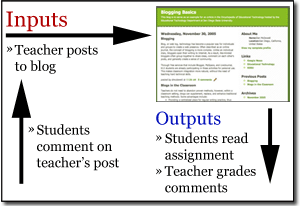 I came across a fantastic article that provides crystal clarity on various blogging techniques that can be employed by teachers. A brilliant piece of expository writing that is well-supported by excellent diagrams (such as the one shown here), this article would be good guide to any teacher in nailing the implementation strategy of her class blog.
Teachers - read and blog away…
That question posed to me by a teacher the other day truly warmed the cockles of my heart (pardon the quaint expression!)…I thought the idea of leveraging her students' new-found interest in poetry through a classroom blog was a brilliant one. Writing poems is just the kind of Language Arts activity that can benefit immensely from a forum for publishing and an audience of readers (for praise and critique) in teachers, parents and most of all, peers.
Blogging in the classroom - it’s a slow but sure trend in urban schools in India - one that I’m happy to fan along in any way I can, because I see such tremendous possibilities in these common platforms for expression and discourse that extend beyond the four walls of the classroom.
Blogs in K-12 can have various purposes – as a quasi-course management site maintained by the teacher alone; or a collaborative platform for sharing ideas by the teacher as well as the students; or a personal space for publishing maintained by individual students that the class (or even the school community at large) has access to. Having used blogs in all these different ways with my students (teachers in professional development programs), I think it’s important for teachers to be aware of the different ways in which blogs can be set up and used – driven, as it were, by the purpose of setting up this collaborative learning space.
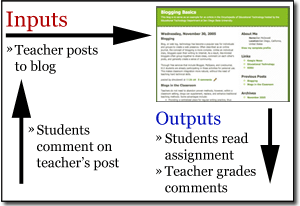 I came across a fantastic article that provides crystal clarity on various blogging techniques that can be employed by teachers. A brilliant piece of expository writing that is well-supported by excellent diagrams (such as the one shown here), this article would be good guide to any teacher in nailing the implementation strategy of her class blog.
Teachers - read and blog away…
Friday, March 17, 2006
Blogging in the Classroom (...not literally!) / Blogging Teachers
A comment on a post here touched on the issue of blogs in education – something I’ve given much thought to over the last year or so. Much has been written about the benefits of blogs especially in the context of K-12 education – mostly ideas around publishing and collaborative learning, facilitated by the ease of setup and use of this tool. The last couple of years have seen a phenomenal rise in the use of blogs in the classroom in the US.
[In keeping my with firm beliefs in first making teachers aware and fluent in the technology we would like them to use], I do think that we cannot expect teachers to design curriculum around blogs unless they’ve experienced blogging first-hand. So teacher awareness about the world of blogs one of the goals I set out to achieve this past year.
Educational Blogging (an article that appeared in the Sept/Oct 2004 issue of Educause) was one of the earlier writings on this subject. It was this article that I distributed to a group of teachers that I work with (at MAIS, Bangalore) as an introduction to the world of blogging in education. As part of the team that was facilitating a teacher professional development program (called Professional Practice and Studies in Education, or PPSE) for these teachers, and designing their coursework, I worked the use of blogs into their PD curriculum – having them reflect on their teaching practice or any other specified topic, on their personal blogs that I helped them set up. (I think a teacher’s blog could serve well as his/her e-portfolio too). I also set up a group blog that would operate as a common platform for discourse on education, or even just for announcements and general communication among the group.
Some of these efforts were also aimed at building a community of practice (CoP). Teaching is known to be (to a large extext) a solitary activity and we wanted to set up modes of communication that would alleviate some of the isolation teachers experience in their profession.
As was expected, some of the 21 teachers who are part of the PPSE program took to blogging more easily than others. All in all, it's been a rewarding experience. The fact that some teachers have started blogs for their subjects with their students is icing on the proverbial cake. Mission Accomplished!!!
(Unfortunately in a country such as ours, hesitancy in written communication in English can be a huge stumbling block in such an endeavor even for some teachers in urban English-medium schools such as 2nd and 3rd language teachers. Will save that for a later discussion…)
[In keeping my with firm beliefs in first making teachers aware and fluent in the technology we would like them to use], I do think that we cannot expect teachers to design curriculum around blogs unless they’ve experienced blogging first-hand. So teacher awareness about the world of blogs one of the goals I set out to achieve this past year.
Educational Blogging (an article that appeared in the Sept/Oct 2004 issue of Educause) was one of the earlier writings on this subject. It was this article that I distributed to a group of teachers that I work with (at MAIS, Bangalore) as an introduction to the world of blogging in education. As part of the team that was facilitating a teacher professional development program (called Professional Practice and Studies in Education, or PPSE) for these teachers, and designing their coursework, I worked the use of blogs into their PD curriculum – having them reflect on their teaching practice or any other specified topic, on their personal blogs that I helped them set up. (I think a teacher’s blog could serve well as his/her e-portfolio too). I also set up a group blog that would operate as a common platform for discourse on education, or even just for announcements and general communication among the group.
Some of these efforts were also aimed at building a community of practice (CoP). Teaching is known to be (to a large extext) a solitary activity and we wanted to set up modes of communication that would alleviate some of the isolation teachers experience in their profession.
As was expected, some of the 21 teachers who are part of the PPSE program took to blogging more easily than others. All in all, it's been a rewarding experience. The fact that some teachers have started blogs for their subjects with their students is icing on the proverbial cake. Mission Accomplished!!!
(Unfortunately in a country such as ours, hesitancy in written communication in English can be a huge stumbling block in such an endeavor even for some teachers in urban English-medium schools such as 2nd and 3rd language teachers. Will save that for a later discussion…)
Subscribe to:
Posts (Atom)