Wednesday, March 07, 2007

Concept Mapping/Mind Mapping as an Educational Tool - The Resources

(Also posted on educatorslog.in)

This is part-2 of the previous post on the use of concept maps in education.


Inspiration has been an industry leader for years now, but it is not free and not cheap either (I am unsure of actual costs for school use). Their website is a good resource, though, for ideas on how to use such tools in the classroom, and for general reading on the educational benefits of concept mapping. They have also come out with Kidspiration - a version for younger kids. Try the free trial versions just to get a sense for the software.

MindManager - is a paid tool with very pleasing aethetics. I doubt anyone (in schools) will need purchase it, now that there's FreeMind and Mindomo (see below). This also has a free trial version you can download and try.

C-Map - is a FREE, good, easy-to-use tool. The information on the home-page of their website also serves to explain all the features of this tool (it's been put together using C-Map itself!).

FreeMind - is like MindManager, except that its FREE! Make sure you install the Java Runtime Environment (JRE) on your machine before using this.

Mindomo - is available in free as well as paid versions. This is a new web-based concept mapping tool (released barely a week ago) that allows the user to create the maps within the web browser itself, which allows for easy sharing and collaboration. The maps look much like the MindManager maps. I have not tried this tool yet, but it does look very promising; only downside being that it needs Internet access for use which presents a very real constraint for schools in India.

bubbl.us - I was recently sent a link to this new 'brainstorming tool', which is also FREE. It seems to be very user-friendly and aesthetically pleasing too and appears to serve the "thinking process" better than some of the older tools. The features described on the site are shown through a bubbl.us map (so what's new about that?). Like Mindomo, this is also an online tool, which is not so good for people in India with limited or no Internet access.

Have fun mapping your mind!

Tuesday, March 06, 2007

Map Thine Own Mind (and that of thy students) ... Concept Mapping/Mind Mapping as an Educational Tool

(Also posted on educatorslog.in)
Prologue: My teacher training modules on concept mapping have always been well-received so I thought I'd share some ideas here as well. This post has been prompted by the discovery of yet another free concept-mapping tool that has been recently released. My next post will talk about the free/paid concept mapping tools that are available.

There is no argument about the educational value of use concept maps (or mind maps - I will use the terms interchangeably here) in the classroom. It is a great tool for critical thinking and for organizing information, and especially so for the visual learner.

For those unfamiliar with the idea of concept/mind mapping - the attached image explains the term and idea through a concept map itself!). To quote the wikipedia (!), "A mind map is a diagram used to represent words, ideas, tasks or other items linked to and arranged radially around a central key word or idea. It is used to generate, visualize, structure and classify ideas, and as an aid in study, organization, problem solving, and decision making."

If the wikipedia is not good enough, here's a blurb from the Inspiration site on the power of visual learning - "Learning to think. Learning to learn. These are the essential skills for student success in every curriculum area and academic pursuit. Research in both educational theory and cognitive psychology tells us that visual learning is among the very best methods for teaching students of all ages how to think and how to learn. "

One could say that a concept map is basically a type of graphic organizer. (e.g. the 'Star' graphic organizer for vocabulary is quite simply a map with the word in the middle and surrounded by cells/nodes which contain the definition, type of word, synonym, antonym, draw a picture, and use the word in a sentence).

Concept Maps can be used by teachers in various aspects of classroom practice - for planning lessons/units, with students at the beginning of a unit/lesson to introduce a topic and gauge students' prior knowledge of the topic, at the end of a unit/lesson to assess student learning, to catch misconceptions students may have about a concept or idea, and for presentations as well (since the newer software mind-mapping tools allow one to add hyperlinks to websites, images, documents, and even other mindmaps).

Information organization is a key skill that kids need to have these days (I will refrain from using the cliched phrase "21st century skill"). I do believe that giving children tools to organize information is especially important today when there is so much information that kids need to deal with and make sense of.

Epilogue: Fortunately for us, there are now several software tools that help us with the task of mind-mapping. I will share these resources in an the next post...

Wednesday, February 28, 2007

Ideacast on Wikinomics

On Harvard Business Online...

Wikinomics

(Also posted on educatorslog.in)

"The art and science of harnessing mass collaboration for innovation and growth" is (roughly) how Don Tapscott describes the term Wikinomics.

For many of us (especially educators interested and involved in issues of technology in education) Don Tapscott's 1987 work Growing Up Digital: The Rise of the Net Generation was mandatory reading in our professional studies. Tapscott's new book Wikinomics:How Mass Collaboration Changes Everything (co-authored with Anthony D. Williams) may well become required reading for students of economics, business management, commerce and for just about anyone wanting to engage actively the ideas of openness and collaboration that this new web is fostering.

"In its latest incarnation, the World Wide Web has become a communal experience—collaborators from anywhere and any walk of life now have the ability to solve problems and produce results through the use of collective wisdom. Although some business leaders may find the prospect of this kind of openness rather frightening, Tapscott believes that leveraging the new wave of community is the way of the future." [Source: Harvard Business Review]

All of us here on this forum for educators too are a part of this new culture of collaboration and dialogue, and "community", that these new authoring and publishing tools of the web have afforded us.

Our teens and youth are a part of it already - through their social networks on orkut, hi5 and others. For those of us teachers with access to the Internet in our schools, how we teach must change as well to use the opportunities that the new web affords for student collaboration, as well as publishing and sharing student work - to prepare our next generation for a world that will be governed to a large extent by Wikinomics.

The $100 laptop

(Also posted on educatorslog.in)

"It's an education project, not a laptop project" is how Nicholas Negroponte describes the landmark One Laptop Per Child (OLPC) project that leverages affordable technology for education.

Last July, India rejected the OLPC idea as "pedagogically suspect" and not "mature enough to be taken seriously at this stage". The announcement must have come as a blow to the project given the size of the Indian market for the product. One cannot argue with India's reasoning - "We need classrooms and teachers more urgently than fancy tools."

The project has progressed since, and the first shipment to the pilot countries (Argentina, Brazil, Libya, Nigeria, Thailand & Uruguay) is happening around now. The OLPC wiki has a wealth of information on the vision, the current state of the project, the timeline, the pedagogy, and tons of other stuff for developers, and anyone else who wants to be engaged in this project in some way. (They are looking for translators to develop content and translate the websites into local languages).

A comment on the pedagogy (the one the Indian government called "suspect") - this project is basically an extension/realization of the beliefs of the Lifelong Kindergarten group at MIT Media Lab; the constructivist pedagogy that Seymour Papert and Mitch Resnick have championed for over 2 decades now. There are links to some good articles from the wiki on these ideas of constructivism. While I agree with the "need for classrooms and teachers in India" rationale, I would personally not call the pedagogy "suspect", and I should add that the National Curriculum Framework of 2005 that came out of our NCERT talks about a "inquiry-based" pedagogy that is akin to constructivism (even if they have not used that particular term). I think the ideas of what education could and should look like, that have emerged from the Media Lab, are sound - they just have not been tried out on such a mass scale, and with tools such as the $100 laptop.

As with all tools for education - technology-based or otherwise - the teacher+tool combination will be key i.e. how well teachers understand them and use them with their students.

Will these delicious-looking machines just be "fancy tools" with no lasting impact on the education landscape of developing countries or will they change the face of education in our lifetime? Is it just another "cutesy" idea to emerge from a developed nation to be tested on poor, developing countries? Only time will tell...until then - India's strategy to wait and watch may not be a bad one. What do you think?

Thursday, February 22, 2007

Citizendium: "Our new compendium of knowledge" is the new Wikipedia

http://en.wikipedia.org/wiki/Citizendium

It's no coincidence that to write an article about the wikipedia, and explain a term that will soon be as much a part of our vocabulary as the term 'wikipedia' is, I am citing a link to the wikipedia itself!

If you are a teacher who uses google for your everyday searching on the Internet, then you must know that for most of the topics that we discuss in class or give our students assignments to "find out about" - a lot of our information today is picked up from this "wiki" that has put been together by thousands of unknown names and faces. We all - teachers and students - are relying on a mass of information put up by anyone and we never really stop to question the quality of this information. In a recent article I read on the issue of the indiscriminate use of the internet in the classroom - this is what I came across (I have not tried it but I am inclined to believe the stats) -

"Wikipedia, the free encyclopedia, dominates all of these searches, appearing in the top ten every time.

  • China - Wikipedia = #1
  • acid rain - Wikipedia = #4
  • Montreal - Wikipedia = #3
  • Charles de Gaulle - Wikipedia = #1
  • Virginia Woolf - Wikipedia = #1"

Anyway, as it turns out, the founders of the Wikipedia are also worried about this trend; and so we have a Citizendium in the works!

"Citizendium works much like Wikipedia in many ways. Both are considered wikis, which are collaborative web sites that represent the ongoing, collective work of many authors. (Similar to a blog in structure and logic, a wiki allows anyone to edit, delete, or modify content that has been placed on the site--including the work of previous authors--using only a browser interface.)"

But unlike the wikipedia, the Citizendium will require contributors to register their names and the project has tapped subject-matter experts to serve as content editors.

I'm sure this will herald even more reckless use of information from the Internet, the only difference will be that the recklessness with the new wiki will be less problematic as far as the quality and sanctity of the information is concerned.

Friday, February 09, 2007

Arvind Gupta and Toys from Everyday Stuff...

Ref. previous post.. here's another youtube video...

My first foray into video sharing...

I had the pleasure of watching toymaker and tinkerer, Arvind Gupta (also winner of the National award for Science Popularization) in action at Mallya Aditi International School, Bangalore where he was invited to spend a few days with 6th-graders. The children enjoyed their time with him immensely - building air and water pumps out of empty toothpaste tubes, straws and empty film roll cannisters, motors out of batteries, magnets and copper wire, sound-makers out of straw, toys and animals from paper and matchboxes and what not.

I uploaded a couple of short videos onto youtube to share it with the kids and teachers (and the whole world, I guess...)

Thursday, February 01, 2007

An Inconvenient Truth - 'you owe it to yourself'


Read more at educatorlogs.in

"Humanity is sitting on a ticking time bomb. If the vast majority of the world's scientists are right, we have just ten years to avert a major catastrophe that could send our entire planet into a tail-spin of epic destruction involving extreme weather, floods, droughts, epidemics and killer heat waves beyond anything we have ever experienced."

 Al Gore's documentary film (which has been nominated for an Oscar in the documentary film category) is a must-see. I can see this film as a great resource for starting discussions in an Environmental Education middle- or high-school class. While the movie focuses mainly on the issue of global warming, it will not take much for a teacher to extend the ideas to topics such as the water crisis, renewable and alternate energy sources, sustainable living...the list is endless. A fabulous effort by the man who introduced himself as - "I'm Al Gore, I used to be the next president of the United States of America."

A quotable quote mentioned in the film (among many) - "You can't make somebody understand something if their salary depends upon them not understanding it." - Upton Sinclair

Tuesday, January 30, 2007

The importance of platforms for professional dialogue


Having just completed a very intellectually stimulating and fulfilling stint as a facilitator on one more successful rendition of an online course on Harvard University's WIDE world professional development platform, I am rejuvenated, and excited at the idea of having a platform such as this one for engaging in professional dialogue with my peers - other educators in India.

Hopefully this will herald the beginning of several relevant and compelling conversations among professionals involved (in different ways) in the significant task of educating our next generation.


(Read more at educatorslog.in)

Saturday, September 09, 2006

Back to Blogging

“Could you help me start a blog for my literature class?”

That question posed to me by a teacher the other day truly warmed the cockles of my heart (pardon the quaint expression!)…I thought the idea of leveraging her students' new-found interest in poetry through a classroom blog was a brilliant one. Writing poems is just the kind of Language Arts activity that can benefit immensely from a forum for publishing and an audience of readers (for praise and critique) in teachers, parents and most of all, peers.

Blogging in the classroom - it’s a slow but sure trend in urban schools in India - one that I’m happy to fan along in any way I can, because I see such tremendous possibilities in these common platforms for expression and discourse that extend beyond the four walls of the classroom.

Blogs in K-12 can have various purposes – as a quasi-course management site maintained by the teacher alone; or a collaborative platform for sharing ideas by the teacher as well as the students; or a personal space for publishing maintained by individual students that the class (or even the school community at large) has access to. Having used blogs in all these different ways with my students (teachers in professional development programs), I think it’s important for teachers to be aware of the different ways in which blogs can be set up and used – driven, as it were, by the purpose of setting up this collaborative learning space.

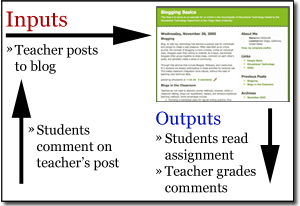
I came across a fantastic article that provides crystal clarity on various blogging techniques that can be employed by teachers. A brilliant piece of expository writing that is well-supported by excellent diagrams (such as the one shown here), this article would be good guide to any teacher in nailing the implementation strategy of her class blog.

Teachers - read and blog away…

Friday, August 25, 2006

"Children, Computers and Powerful Ideas"

My last post about the PICO Cricket kit and the LEGO Mindstorms brought to the fore thoughts on kids and programming that I have dwelt on ever so often...and the book that started it all (and purportedly inspired many of the early adopters of computers in classrooms as well as legions at the Media Lab in the Lifelong Kindergarten group whose research gave birth to the LEGO Mindstorms and now the PICO Cricket).

It's been over a quarter of a century since 'Mindstorms' (Seymour Papert's seminal book on kids and computers) took the education world by storm. The book was less about teaching with/about/from computers (the topical tensions of technology integration in schools) as it was about allowing kids to be creative through computers. 26 years on, and we rarely see kids in schools using computers in the way Papert envisioned - children programming computers and acquiring "a sense of mastery over a piece of the most modern and powerful technology" and through this endeavor establishing "intimate contact with some of the deepest ideas from science, from mathematics, and from the art of intellectual model building." Is it because Papert's argument was not compelling enough or is the jury still out on the educational benefits of such an endeavor? Or is it because teachers (the vast majority of them anyway), dare not stray into the realm of "geeks" (the popular (mis)perception of people who can program) - in the belief that such activity is way too "hi-tech" for them. I tend to think that it is the latter.

Fortunately for us all, there are some who have not given up on this powerful idea. The simple easy-to-use LOGO programming environment (that Papert and his colleagues created at the MIT Media Lab) is still alive and kicking, and available through various sources. Microsoft's Kids Programming Language (KPL), while not as easy as LOGO, seems promising. Squeak based on Smalltalk has been around for a while, and Scratch, slated to be Media Lab's latest gift to kids and educators (who care to share Papert's view) is a WYSIWYG, iconic LOGO-like programming environment.

With no apparent dearth of kids programming environments and certainly no shortage of computers (what with the $100 laptop soon to become a reality in the developing world), the need of the hour is to get teachers to start playing around in these easy-to-use, fun programming environments, so that they can get over their irrational fear of communicating with computers, and start seeing the thrilling possibilities of these powerful learning tools in their classrooms.

Wednesday, August 02, 2006

Chirp, Chirp! Here come the crickets...

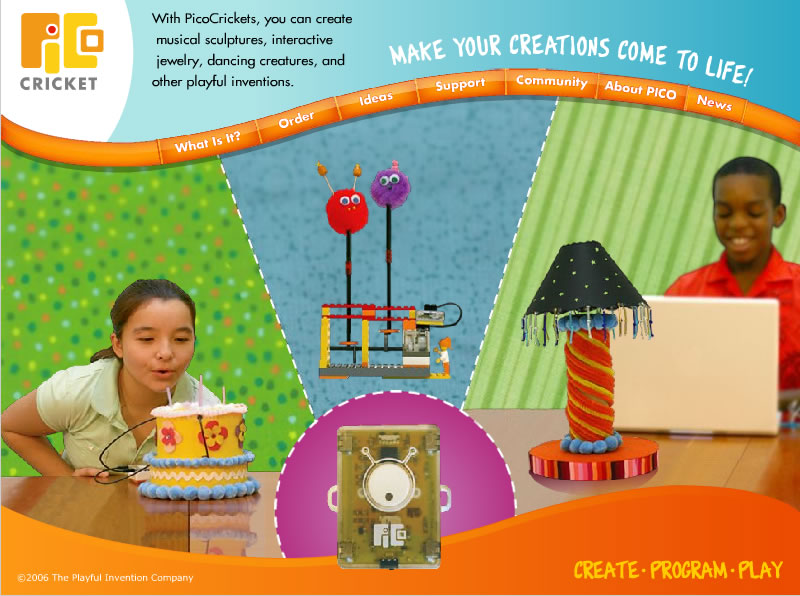
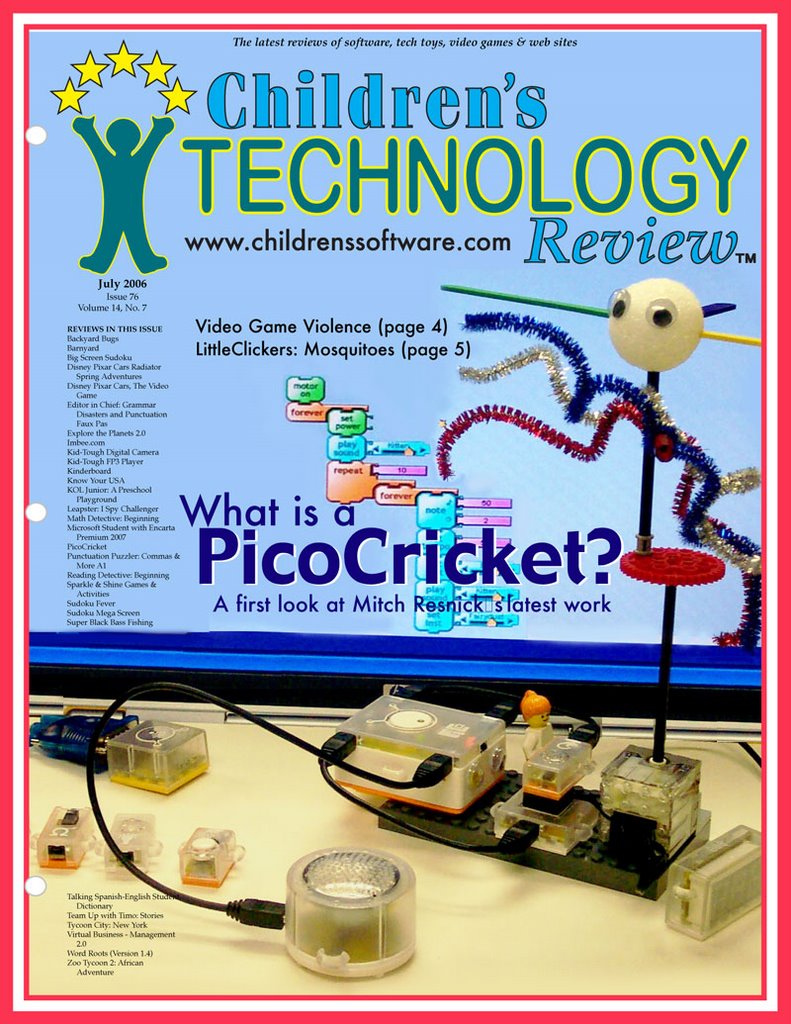
The latest offering to emerge from research at the Lifelong Kindergarten group at MIT Media Lab, has once again got proponents of “hands-on”, creative learning excited in eager anticipation. The PICO Cricket kit, due to be released in the coming weeks presents some thrilling possibilities for informal learning spaces. As someone who volunteered for the workshops at MIT Museum in 2003 during the ‘Playful Invention & Exploration’ (PIE) research project, I have a personal connection as well with this product.


Sidhanth at a PIE Workshop
PIE Workshops at the MIT Museum - Pictures of my (then) 6-year old son at the 'e-Insect Invasion' workshop in April 2003


Simply put, PicoCricket is “a LEGO Mindstorms Robotics Kit meets a Klutz Craft Kit” i.e. LEGO pieces + ‘Electronic Thingees’ + Craft materials, where ‘Electronic Thingees’ = a microcomputer (the legendary MIT Media Lab “cricket” encased in a plastic body, much like the LEGO RCX brick), LEDs, sensors & motors. The colorful craft materials range from foam balls to pipe cleaners to straws, beads and buttons. [In the hands of a resourceful, creative individual, the kit could be “enhanced” by any number of “craft materials” from all around us - there is no dearth of plastic and metal knick-knacks that could be recycled to find a new home - and use.]

What differentiates this product from the Mindstorms, is, of course, the emphasis on creativity and craft, which as I see, will serve to bridge the technology gender divide (I speak from first-hand experience – boys have outnumbered girls by far in the after-school Robotics Club I have run for high-schoolers for the past 3 years). It is not only the inclusion of craft materials that sets this apart from the Mindstorms, but also the exclusion of the vast numbers of wheels, axles, tires, treads and hubs, that account for a large percentage of the Mindstorms kit. Kids take one look at the Mindstorms kit and “roving bots on wheels” is probably the first "robot" idea that strikes them. One look at the Crickets kit and kids could think of a zillion different exciting, colorful artifacts. "Arts & Crafts for the Digital Age", is how NYT has described it.

At $250, this kit seems quite pricey (more so for the Indian market), especially given that the LEGO Mindstorms NXT seems to have a lot more (in terms of sheer size of the kit) for the same price; but that has not deterred critics from giving this product a thumbs-up. (I queried Mitch Resnick at the Media Lab about this when he showed me the Cricket kit this past spring; he thinks that bulk production - driven by demand, will hopefully bring down the price some time in the future).

I, for one, cannot wait to get my hands on one of these ...

Thursday, July 06, 2006

On The Social Side of Bookmarking...A Delicious Idea for Teachers & Schools

Consider the following issues teachers in our school (and I’m sure elsewhere as well) are dealing with when trying to use resources on the Internet ---

  1. They search for websites appropriate for a particular topic they are teaching. They would like to share these with their students in school, but the links sit bookmarked on their computers at home.

  2. The teachers identify certain useful sites on a computer in school or at home, and bookmark them, but do not have access to the same machine all the time.

  3. Technology teachers and integration specialists working with teachers in school identify certain useful websites for the teachers they’re working with and need a convenient mechanism to share these with them.

  4. Teachers of different grades/subjects would like to be able to know what websites other teachers teaching the same subject have found useful in their teaching. If only there were an accessible “database” of useful web links that their colleagues have used or found potentially useful, (as opposed to some the links some strangers somewhere half-way across the globe found useful.)

For all this and more, del.icio.us to the rescue!

Here’s how it would work---

  • The tech. staff would set up a common del.icio.us account for the school community to maintain a handy, accessible database of useful web links, as well as for facilitating easy sharing among teachers, tech corordinators, students and anyone else in the school community who would benefit from access to this set of links.
    For example, a del.icio.us account with an appropriately friendly username such as “tech_(school-name)” or “weblinks_for_(school-name)” would be set up.

  • The username and password would be shared with the teaching community.

  • Teachers who wish to add a web link to share with students or other teachers, would login and add to the list.

Voila! Teachers now have easy access from anywhere – home, classroom, computer lab, …to this wealth of contextual, school-appropriate set of web links at http://del.icio.us/(whatever username has been set up)

Now for the tagging bit (which is basically a form of information organization, where you associate keywords with any web link)---

  • The weblinks added on del.icio.us need to be ‘tagged’ appropriately for search-and-access by the users themselves or even the del.icio.us community-at-large (after all “social tagging” is the big idea!).

  • In the case of a school community, teachers could tag the web link with keywords indicative of grade level(s), subject, or topic… that the web link could be used for.

  • Teachers wanting to share links with their students, could use del.icio.us and tag a set of links s/he may have identified from the existing list, or added to the list. In this case, the tags could be indicative of the topic or something the teachers and students arrive at jointly.

Having a common understanding, and perhaps even shared “rules” (among teachers and students), of the semantics and syntax used for tagging, would, of course, be key, to making this type of sharing a success.

There are other 'folksonomic' tools such as Clipmarks that do much the same thing as del.icio.us (but I have not tried them yet). There is also a another - wider - aspect to this type of "social tagging" - that which deals with your connection to others across the globe who have tagged the same link as you (most likely other teachers or educators with similar interests), but I'll save that for another post.

Wednesday, June 21, 2006

Trackstar?...Webquests?...Filamentality!!!

[Shantu-This one's for you...your recent experiences with Trackstar (that you shared in your comment to my Trackstar post - thanks!) and your plans to make a webquest one of these days, make me think you should give this one other tool a shot as well...]

For teachers interested in scaffolding the internet search process for students and creating instructional materials for them that organizes websites (that teachers have pre-identified) around key questions and ideas...try Filamentality. It's "a fill-in-the-blank tool that guides you through picking a topic, searching the Internet, gathering good Internet links, and turning them into online learning activities." These online activities could be in the following formats-
(Source: Filamentality site)
  • Hotlist: A reasonable first step is to simply compile a list of web-based resources - i.e. a good "Hotlist" of sites you know are appropriate for your users. These pages might not be standards-based or geared toward a specific learning outcome, but it will be like wheeling a bunch of good books from the library into the classroom.
  • Treasure Hunt: If learners are emotionally connected to the topic, then ask the question, "Are they learning enough background information on the subject?" If the answer is no or if the best information on the subject is "hot off the press," then try a Treasure Hunt.
  • Subject Sampler: If learners have factual knowledge about a subject, then ask yourself, "Do they come out of the unit affectively engaged?" If they don't seem to care about the subject as you think they should, try creating a Subject Sampler.
  • Multimedia Scrapbook: If you want students to explore a variety of sites that you've selected and create their own reports, newsletters, presentation stacks, or posters using "pieces" from those sites, you might try making a Multimedia Scrapbook.
  • WebQuest: If they learn facts, but don't pursue higher-level thinking; why not make a WebQuest? A webquest uses the sites you select as the starting point for a complex activity that involves multiple perspectives, possible group collaboration, and a final project of your choosing.

How's that for options!?

Sunday, June 18, 2006

Webquests

For those teachers visiting my blog and wanting to know about webquests, and more importantly, how to create them, this site hosted by San Diego State University is a good primer. Will post more thoughts on Webquests shortly...

Saturday, June 17, 2006

BEWARE OF THE WOLVES THAT LURK IN THE DEEP, DARK FOREST THAT IS THE INTERNET

[I wrote this article recently and have sent it to a local newspaper for publishing as well.]

More often than not, teachers and parents of teens are blissfully unaware of what their kids are up to when they are on the Internet. For those of us keeping tabs on issues of kid safety on the Internet, nary a week goes by these days without the mention of some nightmarish teen experience related to their Internet explorations, or what the big players in the Internet “Social Networking” space (Microsoft, Google, Yahoo and others) are doing (or rather attempting to do) to make their software tools safer for teen-use. The truth is that nothing works better than raising awareness levels among schools, teachers, parents, and above all, kids themselves, of the potential dangers that lurk in Internet chat rooms and social spaces, as well as in the seemingly innocuous act of music/video file sharing.

At a recent workshop I conducted for teachers of Mallya Aditi International school, Bangalore, on issues of Internet use by teachers and kids in their teaching & learning, the section on safe use of the Internet was an eye-opener, and prompted a session dedicated solely to this topic, with parents of middle-schoolers in the same school. This article is prompted by the earnest plea of the teachers and parents who attended these sessions that I get the word out and reach many more parents/teachers who live in blissful ignorance of these very real dangers.

Types of Risks
The 4 types of risks that I associate with Internet use among kids in urban India are –

  1. Harmful relationships with online strangers
  2. Peer-to-Peer File Sharing
  3. Access to Inappropriate Material, and,
  4. Loss of Privacy - which is a potential danger inherent in almost all online interactions with others, especially strangers.

Harmful Relationships With Online Strangers
This is very likely to happen if your kids are visiting unmoderated chat rooms, chatting on MSN Messenger, Yahoo Instant Messaging, Skype or GMail chat. Pedophiles have been known to frequent chat rooms that are popular with children and teens. This may also happen through the vast number of “social networking” and blogging sites that have burgeoned on the Internet. Social networking sites such as MySpace, Facebook, Google’s Orkut, MSN Spaces, Xanga and Hi5 are becoming increasingly popular with teens even in India, for chatting, exchanging photos and extending their network of “friends”. While several of these mandate a minimum age requirement of 14 or 15, there is obviously no system of verification.
Recent stories from the US such as the assault on a teenager that was linked to her presence on Myspace and that of teen Justin Berry, while extreme and not everyday occurrences, stand as testimonials to the horrific turn that some innocent Internet explorations can take, especially when kids use webcams along with Chat.

Child Safety Tips for Chatting and Blogging and “Social Networking” on the Internet-
• Do not visit unmoderated chat rooms.
• Only chat with people you know and have met in person, preferably kids your own age.
• Keep your profile as anonymous as possible. Do not provide your full name, address, phone number, or school information in your user profile.
• Because many spammers use names they can easily collect from a chat room, consider having a "chat" screen name. This name would be one that is different than your e-mail address. This could help prevent unwanted Spam mail from coming to you.
• Never agree to give out personal information in a chat conversation with anyone.
• Never to agree to get together with anyone you meet in a chat room without first checking with your parents.
• Always remember that people are not always who they seem to be on the Internet.
• Be wary of the use of webcams.
• Never post a photograph on the Internet without getting your parents’ permission. In general, avoid posting photos. Remember that things have a way of staying online forever; what may be done with your photos (even ones you send to “friends”) may be beyond your control.
• Don’t lie about your age on social networking sites. If you are too young to sign up, have your parents find an alternative that is age-appropriate for you.

Peer-to-Peer File Sharing
Does your child download mp3 music files off of the Internet? Chances are the he/she is doing this in violation of the law. Hundreds of children in urban India are using Peer-to-Peer or P2P file sharing applications such as Kazaa, Limewire and Morpheus to illegally download copyrighted music files from the Internet. These programs work by providing access to a portion of your computer to everyone else on the network and vice versa. The risks and downsides to doing this are many-
· Computers on P2P networks are vulnerable to viruses, spyware and other malignant code. A harmless-looking music file may be bundled with a virus or spyware that then gets access to your computer
· More that 35% of the total P2P traffic is pornographic in nature. Your child may inadvertently download age-inappropriate, sexually explicit material.
· There is a danger of strangers getting access to sensitive information on your computer, related to your finances or employment.
· Some day the law may catch up with violators of Copyright Law. Music sharing through these means is illegal.

So what is the solution to this? Join a paid music club and download music legally.

Access to Inappropriate Material on the Internet
...is usually just a click away! This material could be of a sexually explicit nature, be violent and hateful, or may advocate and glorify the use of drugs, weapons, alcohol or tobacco.

Ever misspelled a URL (a website address) and had a pornographic site load up? Not long ago, misspelling google.com with an extra ‘l’ brought up an asian porn site. Several parents and teachers have had embarrassing experiences with children searching on school-related material using seemingly innocuous keywords on Google. Among the tricks pornographers have been known to use is the linking of kid-friendly keywords such as “pokemon” and “Action Man” to porn sites.

The solution?

  • Encourage kids to use kid-safe search engines such as Onekey and ensure that you are using “Strict” Search Preferences on Google.
  • Educate your kids about the presence of inappropriate material.
  • Bookmark child-friendly web sites. This allows your children to easily get to safe sites that they have used before.
  • Teach children to crash and tell. If they encounter a bad experience, they should feel comfortable in immediately turning off the computer and talking with you about the experience
  • Teach children to never open email from someone they don't know.
  • Never respond to an ‘Unsubscribe’ on a pornographic email.

So what else can you do as a parent or teacher?

  • Place your computer in an open room with the monitor in plain view. This allows you to keep tabs on your child's online activities.
  • Limit the amount of time your kids spend on the Internet.
  • Have up-to-date anti-virus software protection for your computer
  • Consider installing software that filters specific sites and/or monitors online activity.
  • Consider not allowing your kids to go online when you are not home.
  • Find time to stay up-to-date on issues of kid safety on the Internet. There are several relevant sites such as http://www.safekids.com/ and http://www.wiredsafety.org/.
  • Finally, remember that there is absolutely no substitute for adult supervision of your kids’ online activity.

Wednesday, April 19, 2006

Trackstar is a star (...and so am I)!

Finally got around to conducting the workshop on 'Internet Use in Schools' described in my previous post. It was a "huge hit" (those are a participant's words - but I would have said something similar anyway - one does have a sense for how things have gone down in a workshop.)

Thirty teachers - mostly from elementary school - attended. While they learnt a lot more about google and how it works, gained a good sense for what children below 11-12 years of age are - and are not - capable of in terms of information-gathering from the Internet, as well as issues of 'copy-pasting' and child safety, it was the new tool Trackstar, that I introduced to them, was truly the star of the event. The tool allows a teacher to create a "track" of websites (that s/he would typically have identified prior to, or during, a unit) along with annotations(questions/notes or things for students to keep in mind). The track number is all that the students then need to go to the web page (at home or in school) that contains all the websites (along with annotations) - that come up as frames within the Trackstar site. Safe and productive, especially for elementary school students.

The section on kid safety on the Internet was an eye-opener for teachers. One of them asked me to have a session on this subject in June with the parents of her incoming 6th grade class. The teachers also agreed to make 'OneKey' - the kidsafe version of google that I made them try out - the homepage for all computers in the school labs. I have also decided to make a "Search" link on the IE toolbars in school that will link to 'onekey'.

An 'inspired' science teacher wrote me the same evening about having created a "track" for her 7th grade students, on the topic of environmental science. Felt good to get that email - felt like I had accomplished something that day...

Sunday, April 16, 2006

Google Page Creator (GPC) - Arrgghhh!

So I was supposed to conduct this workshop last Thursday (April 13th) for teachers on "Searching on the Internet". Teachers (like everyone else) are increasingly searching (or rather google-ing) the Internet for information on topics related to the curriculum (as they should) and expecting kids as young as 7 and 8 years old to do the same - notwithstanding the fact that good searching requires some higher order thinking skills and a level of general awareness that makes it difficult for young kids to pull it off without adult help. The focus of this workshop was to be on --

  • how to conduct better searches (handy tips on coming up with good keywords based on how Google works),
  • how to scaffold the process of information gathering for elementary school children (using Trackstar, or del.icio.us or plain ol' bookmark folders in the classroom computers),
  • critical evaluation of websites (making it a conscious process for the naive user - as well as kids - until practice and more awareness makes it the intuitive process it is for many of us),
  • plagiarism (many kids do not even realize that they may be committing a wrong-doing by extensively cutting-and-pasting to prepare a report!), and
  • child safety on the Internet (if you're going to let them loose in this deep, dark forest, know that there are bad wolves lurking behind many a tree - parents and teachers in India are abominably clueless!)

So, what does GPC have to do with all of this? Well, crazed fans of Rajkumar ('demigod' filmstar) in Bangalore made sure that the workshop be postponed and roughly 36 hours on Wednesday & Thursday be spent completely locked up indoors (esp. if you live a couple of streets away from Rajkumar's residence like I do). Putting up a website with the newly approved 'googlepages' account seemed like a great way to spend time - and one that would finally be a 'home' for the nearly 100 pictures from my Robotics club sessions, certainly a very worthwhile cause as well. Late last night (Saturday, April 15th), I finished publishing this plain-jane website comprising only 8 pages.

So, what transpired in between Thursday and Saturday? An unspeakably frustrating (pulling teeth…?) experience with Google Page Creator. Without ranting in too much detail I will just say that this terribly buggy piece of software (yeah! yeah! I know it's a beta version) that allows you so little flexibility in designing your website, is a blot in Google's product suite. If I weren't so pig-headed about sorting and putting up these pictures that I'd been promising my Robotics students for years, I'd have actually felt good about abandoning the project! 100 MB of ad-free space on the google server for a website plus 100 file uploads (I even uploaded some other images for access on some other sites) is tempting, but waiting for a better version of this software would be not be un-smart at all.

While painfully perservering through the entire website creation process, I often wondered about the intended user profile from Google's viewpoint. I could think of no one other than young school kids - my 7-year old son was ecstatic when he was able to put up his very own website in about 1/2 an hour!

Well, the site is up (phew!) – and I think I deserve another 36 hours (not necessarily cooped up indoors) to recover…..!

Friday, April 14, 2006

Innovation!


(Disclaimer: Though this does not relate very directly to issues of Technology & Education, if you try hard, you could draw some tangential links [smile]).

While on the subject of creativity, thought I'd devote a few bits n bytes to its close friend 'Innovation' .

The cover story of the latest issue of Business Week is about the World's Most Innovative Companies. (The rest of the issue also dedicates much real estate to the subject of Innovation.) The usual suspects all made the cut - Google, Apple, IBM, Starbucks...

Funnily though, while the main story states that (unlike in the 1990s) "Innovation (today) does not have to have anything to do with technology", most of the products/ideas that featured in the slide-show of innovations (about 16 out of 25) had much to do with technology!

Open Innovation is a big theme that is being talked about and touted as the way to go. "These days the world is your R&D lab. Customers are co-opting technology and morphing products into their own inventions. Many companies are scouting for outside ideas they can develop in-house, embracing the open-source movement, and joining up with suppliers or even competitors on big projects that will make them more efficient and more powerful."

Interestingly, according to the article, India (at par with China) is being viewed as a major "source" of innovation and companies are looking to set up product development centers here. So, how should schools produce and prepare this generation of Indian innovators that the world is pinning its hopes on? "Teaching for creativity" (as opposed to "creative teaching") might well have some answers - instilling in our students that skill of possibility thinking ...